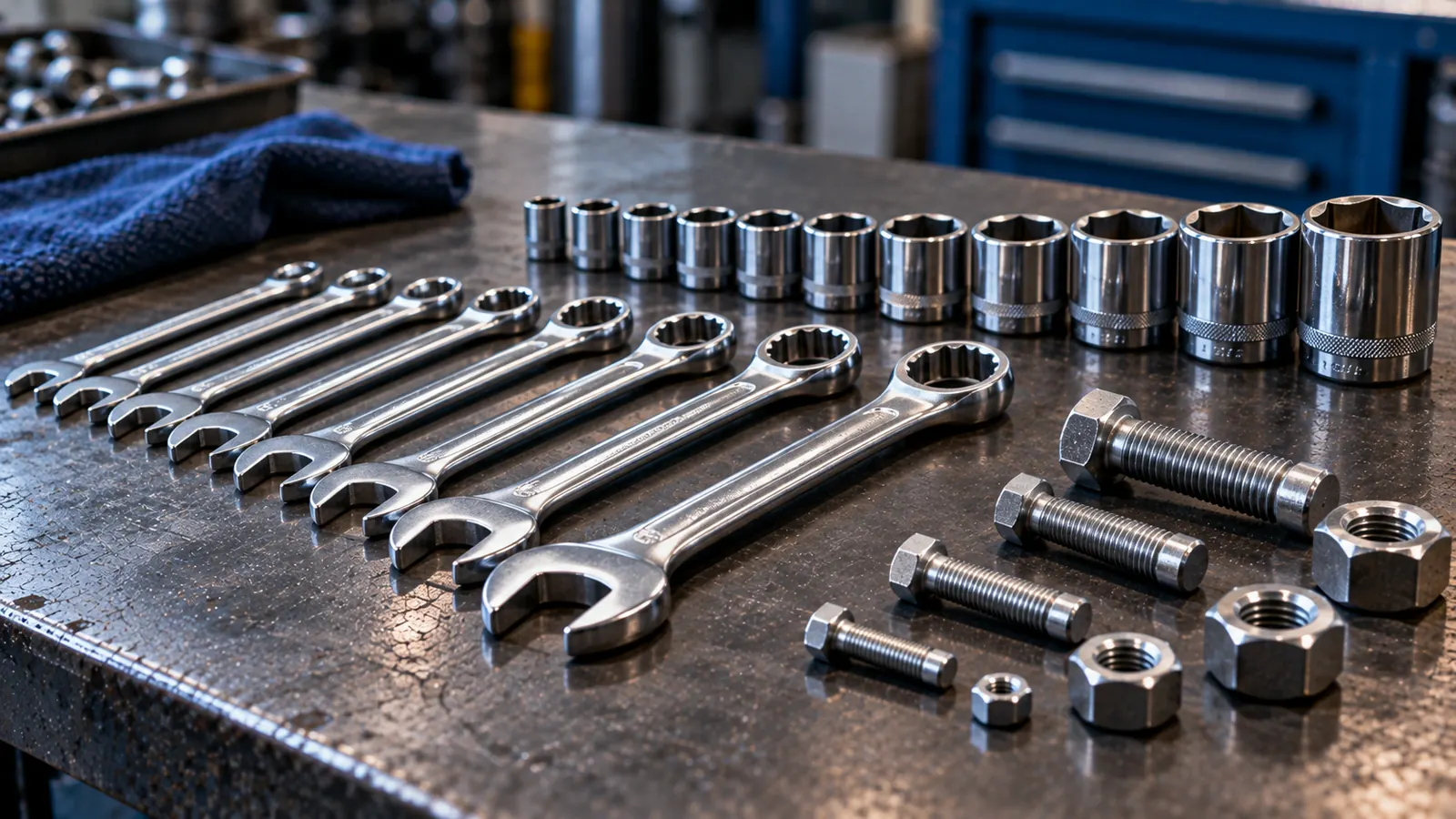
Bolt size chart with wrench and socket sizes
This bolt size chart gives the wrench for each bolt: M6 takes 10 mm, M8 13 mm, M10 16 mm (17 mm DIN), M12 18 mm (19 mm DIN); 1/4 in takes 7/16 in, 3/8 in takes 9/16 in and 1/2 in takes 3/4 in. Only a few metric and standard sockets match: 8 mm ≈ 5/16 in and 19 mm ≈ 3/4 in.
Key takeaways
- M8 bolts take a 13 mm wrench; M10 take 16 mm (ISO) or 17 mm (DIN).
- 1/4 in bolts take a 7/16 in wrench, 3/8 in take 9/16 in, 1/2 in take 3/4 in.
- True metric to standard socket matches: 8 mm and 5/16 in, 19 mm and 3/4 in, 27 mm and 1-1/16 in.
- M10 × 1.5 × 40 means 10 mm diameter, 1.5 mm pitch, 40 mm long.
- Numbered screw diameter = 0.060 + 0.013 × number in inches; #10 is 0.190 in.
Bolt size chart: metric bolts and wrench sizes
This bolt size chart lists each metric bolt with its thread pitch, wrench size, hex key and tap drill. The most common metric sizes take these wrenches: M6 10 mm, M8 13 mm, M10 16 mm (17 mm on DIN bolts), M12 18 mm (19 mm DIN) and M16 24 mm.
Metric bolt sizes are named by nominal (major) diameter in millimetres: an M10 bolt has a 10 mm thread. The wrench size is the distance across the flats of the hex head, which is larger than the thread. Two head standards are in use: ISO 4014/4017 and the older DIN 931/933. They differ at M10, M12, M14 and M22, which is why some M10 bolts take a 16 mm wrench and others a 17 mm.
| Size | Coarse pitch (mm) | Fine pitch (mm) | Wrench, ISO 4014/4017 | Wrench, DIN 931/933 | Hex key, socket head (ISO 4762) | Tap drill | Clearance hole, normal (ISO 273) |
|---|---|---|---|---|---|---|---|
| M4 | 0.7 | 0.5 | 7 mm | 7 mm | 3 mm | 3.3 mm | 4.5 mm |
| M5 | 0.8 | 0.5 | 8 mm | 8 mm | 4 mm | 4.2 mm | 5.5 mm |
| M6 | 1 | 0.75 | 10 mm | 10 mm | 5 mm | 5 mm | 6.6 mm |
| M8 | 1.25 | 1 | 13 mm | 13 mm | 6 mm | 6.8 mm | 9 mm |
| M10 | 1.5 | 1, 1.25 | 16 mm | 17 mm | 8 mm | 8.5 mm | 11 mm |
| M12 | 1.75 | 1.25, 1.5 | 18 mm | 19 mm | 10 mm | 10.2 mm | 13.5 mm |
| M14 | 2 | 1.5 | 21 mm | 22 mm | 12 mm | 12 mm | 15.5 mm |
| M16 | 2 | 1.5 | 24 mm | 24 mm | 14 mm | 14 mm | 17.5 mm |
| M18 | 2.5 | 1.5 | 27 mm | 27 mm | 14 mm | 15.5 mm | 20 mm |
| M20 | 2.5 | 1.5 | 30 mm | 30 mm | 17 mm | 17.5 mm | 22 mm |
| M22 | 2.5 | 1.5 | 34 mm | 32 mm | 17 mm | 19.5 mm | 24 mm |
| M24 | 3 | 2 | 36 mm | 36 mm | 19 mm | 21 mm | 26 mm |
| M27 | 3 | 2 | 41 mm | 41 mm | 19 mm | 24 mm | 30 mm |
| M30 | 3.5 | 2 | 46 mm | 46 mm | 22 mm | 26.5 mm | 33 mm |
| M33 | 3.5 | — | 50 mm | 50 mm | 24 mm | 29.5 mm | 36 mm |
| M36 | 4 | — | 55 mm | 55 mm | 27 mm | 32 mm | 39 mm |
Hex nuts follow the same pattern: ISO 4032 nuts use the ISO wrench sizes and DIN 934 nuts use the DIN sizes. Tightening torque for each size is on its page, for example M8, M10 and M12. Clearance holes in three fits are covered in the clearance hole size chart.
Metric screw dimensions: M2 to M20 socket head cap screws
Socket head cap screws (ISO 4762, formerly DIN 912) have a round head with a hex socket. The head height equals the thread diameter and the head diameter is roughly 1.5 to 1.8 times the thread diameter.
| Socket head cap screw | Thread diameter | Head diameter (max) | Head height | Hex key |
|---|---|---|---|---|
| M2 × 0.4 | 2 mm | 3.8 mm | 2 mm | 1.5 mm |
| M2.5 × 0.45 | 2.5 mm | 4.5 mm | 2.5 mm | 2 mm |
| M3 × 0.5 | 3 mm | 5.5 mm | 3 mm | 2.5 mm |
| M4 × 0.7 | 4 mm | 7 mm | 4 mm | 3 mm |
| M5 × 0.8 | 5 mm | 8.5 mm | 5 mm | 4 mm |
| M6 × 1 | 6 mm | 10 mm | 6 mm | 5 mm |
| M8 × 1.25 | 8 mm | 13 mm | 8 mm | 6 mm |
| M10 × 1.5 | 10 mm | 16 mm | 10 mm | 8 mm |
| M12 × 1.75 | 12 mm | 18 mm | 12 mm | 10 mm |
| M16 × 2 | 16 mm | 24 mm | 16 mm | 14 mm |
| M20 × 2.5 | 20 mm | 30 mm | 20 mm | 17 mm |
An M3 screw has a 3 mm thread with a 0.5 mm coarse pitch; as a socket head cap screw its head is 5.5 mm across and takes a 2.5 mm hex key. An M3 hex head screw takes a 5.5 mm wrench. An M4 socket head takes a 3 mm key and an M4 hex head a 7 mm wrench.
SAE bolt size chart: inch bolts and wrench sizes
Inch bolts are named by nominal diameter and threads per inch (TPI). The usual hex bolt wrench is about 1.5 times the diameter, a little more on the smallest sizes: 1/4 in takes 7/16 in, 3/8 in takes 9/16 in and 1/2 in takes 3/4 in.
| Bolt size | Diameter in mm | UNC TPI | UNF TPI | Hex bolt head wrench | Hex nut wrench | Hex key, socket head |
|---|---|---|---|---|---|---|
| 1/4 in | 6.35 mm | 20 | 28 | 7/16 in | 7/16 in | 3/16 |
| 5/16 in | 7.94 mm | 18 | 24 | 1/2 in | 1/2 in | 1/4 |
| 3/8 in | 9.52 mm | 16 | 24 | 9/16 in | 9/16 in | 5/16 |
| 7/16 in | 11.11 mm | 14 | 20 | 5/8 in | 11/16 in | 3/8 |
| 1/2 in | 12.70 mm | 13 | 20 | 3/4 in | 3/4 in | 3/8 |
| 9/16 in | 14.29 mm | 12 | 18 | 13/16 in | 7/8 in | — |
| 5/8 in | 15.88 mm | 11 | 18 | 15/16 in | 15/16 in | 1/2 |
| 3/4 in | 19.05 mm | 10 | 16 | 1-1/8 in | 1-1/8 in | 5/8 |
| 7/8 in | 22.22 mm | 9 | 14 | 1-5/16 in | 1-5/16 in | 3/4 |
| 1 in | 25.40 mm | 8 | 12 | 1-1/2 in | 1-1/2 in | 3/4 |
Head wrench sizes are for standard finished hex bolts and cap screws (ASME B18.2.1). Note the two exceptions on nuts: a 7/16 in hex nut takes an 11/16 in wrench, not 5/8 in, and a 9/16 in hex nut takes 7/8 in, not 13/16 in. Heavy hex bolts and nuts, used in structural steel, are larger again.
Machine screw sizes: #4, #6, #8, #10 and #12 screw diameter
Numbered screws below 1/4 in have a major diameter of 0.060 in + 0.013 in × the gauge number. A #8 screw is 0.164 in (4.17 mm), a #10 is 0.190 in (4.83 mm) and a #12 is 0.216 in (5.49 mm). The second number in a size such as 8-32 is the thread count per inch.
| Screw size | Major diameter | In mm | Coarse TPI (UNC) | Fine TPI (UNF) | Hex key, socket head |
|---|---|---|---|---|---|
| #1 | 0.073 in | 1.85 mm | 64 | 72 | — |
| #2 | 0.086 in | 2.18 mm | 56 | 64 | 5/64 |
| #3 | 0.099 in | 2.51 mm | 48 | 56 | — |
| #4 | 0.112 in | 2.84 mm | 40 | 48 | 3/32 |
| #5 | 0.125 in | 3.17 mm | 40 | 44 | — |
| #6 | 0.138 in | 3.51 mm | 32 | 40 | 7/64 |
| #8 | 0.164 in | 4.17 mm | 32 | 36 | 9/64 |
| #10 | 0.190 in | 4.83 mm | 24 | 32 | 5/32 |
| #12 | 0.216 in | 5.49 mm | 24 | 28 | — |
So a 4-40 screw is 0.112 in (2.84 mm) in diameter with 40 threads per inch, an 8-32 screw is 0.164 in (4.17 mm) with 32 TPI, and a 10-32 screw is 0.190 in (4.83 mm) with 32 TPI. For more on coarse and fine series, see UNC vs UNF threads.
Metric to standard socket conversion chart
Only a few metric and SAE (standard) sockets are true equivalents: 8 mm matches 5/16 in, 19 mm matches 3/4 in and 27 mm matches 1-1/16 in. Most others differ by more than 0.1 mm and either will not fit or will round the fastener. Use the right system wherever you can.
The table compares each metric size with the nearest SAE socket by actual size. A positive difference means the SAE socket is larger than the metric hex.
| Metric socket or fastener | Nearest SAE socket | SAE size in mm | Difference | Using the SAE socket on the metric fastener |
|---|---|---|---|---|
| 6 mm | 1/4 in | 6.35 mm | +0.35 mm | Fits loose; light duty only |
| 7 mm | 1/4 in | 6.35 mm | -0.65 mm | Too small; will not fit |
| 8 mm | 5/16 in | 7.94 mm | -0.06 mm | Interchangeable |
| 9 mm | 11/32 in | 8.73 mm | -0.27 mm | Too small; will not fit |
| 10 mm | 3/8 in | 9.52 mm | -0.48 mm | Too small; will not fit |
| 11 mm | 7/16 in | 11.11 mm | +0.11 mm | Fits loose; light duty only |
| 12 mm | 1/2 in | 12.70 mm | +0.70 mm | Fits loose; light duty only |
| 13 mm | 1/2 in | 12.70 mm | -0.30 mm | Too small; will not fit |
| 14 mm | 9/16 in | 14.29 mm | +0.29 mm | Fits loose; light duty only |
| 15 mm | 9/16 in | 14.29 mm | -0.71 mm | Too small; will not fit |
| 16 mm | 5/8 in | 15.88 mm | -0.12 mm | Smaller; tight or will not fit |
| 17 mm | 11/16 in | 17.46 mm | +0.46 mm | Fits loose; light duty only |
| 18 mm | 11/16 in | 17.46 mm | -0.54 mm | Too small; will not fit |
| 19 mm | 3/4 in | 19.05 mm | +0.05 mm | Interchangeable |
| 21 mm | 13/16 in | 20.64 mm | -0.36 mm | Too small; will not fit |
| 22 mm | 7/8 in | 22.22 mm | +0.22 mm | Fits loose; light duty only |
| 24 mm | 15/16 in | 23.81 mm | -0.19 mm | Smaller; tight or will not fit |
| 27 mm | 1-1/16 in | 26.99 mm | -0.01 mm | Interchangeable |
| 30 mm | 1-3/16 in | 30.16 mm | +0.16 mm | Fits loose; light duty only |
| 32 mm | 1-1/4 in | 31.75 mm | -0.25 mm | Smaller; tight or will not fit |
| 36 mm | 1-7/16 in | 36.51 mm | +0.51 mm | Fits loose; light duty only |
Standard to metric socket conversion
| SAE socket or fastener | Size in mm | Nearest metric socket | Difference | Using the metric socket on the SAE fastener |
|---|---|---|---|---|
| 1/4 in | 6.35 mm | 6 mm | -0.35 mm | Too small; will not fit |
| 5/16 in | 7.94 mm | 8 mm | +0.06 mm | Interchangeable |
| 3/8 in | 9.52 mm | 10 mm | +0.48 mm | Fits loose; light duty only |
| 7/16 in | 11.11 mm | 11 mm | -0.11 mm | Smaller; tight or will not fit |
| 1/2 in | 12.70 mm | 13 mm | +0.30 mm | Fits loose; light duty only |
| 9/16 in | 14.29 mm | 14 mm | -0.29 mm | Too small; will not fit |
| 5/8 in | 15.88 mm | 16 mm | +0.12 mm | Fits loose; light duty only |
| 11/16 in | 17.46 mm | 17 mm | -0.46 mm | Too small; will not fit |
| 3/4 in | 19.05 mm | 19 mm | -0.05 mm | Interchangeable |
| 13/16 in | 20.64 mm | 21 mm | +0.36 mm | Fits loose; light duty only |
| 7/8 in | 22.22 mm | 22 mm | -0.22 mm | Smaller; tight or will not fit |
| 15/16 in | 23.81 mm | 24 mm | +0.19 mm | Fits loose; light duty only |
| 1 in | 25.40 mm | 25 mm | -0.40 mm | Too small; will not fit |
| 1-1/16 in | 26.99 mm | 27 mm | +0.01 mm | Interchangeable |
| 1-1/8 in | 28.57 mm | 29 mm | +0.43 mm | Fits loose; light duty only |
| 1-1/4 in | 31.75 mm | 32 mm | +0.25 mm | Fits loose; light duty only |
| 1-5/16 in | 33.34 mm | 33 mm | -0.34 mm | Too small; will not fit |
| 1-1/2 in | 38.10 mm | 38 mm | -0.10 mm | Interchangeable |
Rule of thumb used in these tables: within 0.10 mm the sockets are treated as interchangeable; a larger socket by more than that fits loosely and risks rounding the corners under load; a socket smaller by up to 0.25 mm may go on tight or not at all, and anything smaller will not go on. Actual sockets are made slightly oversize and fastener heads slightly undersize, so a near miss can still feel tight. Never hammer a socket onto a hex. For conversions between fractions, decimals and millimetres, use the inch to mm chart.
How to read bolt sizes: M10 × 1.5 × 40
A metric bolt size such as M10 × 1.5 × 40 means an ISO metric thread (M), 10 mm nominal diameter, 1.5 mm pitch and 40 mm length. When the pitch is left out, as in M10 × 40, the coarse pitch is meant.
- M: ISO metric thread with a 60° profile.
- 10: nominal (major) diameter in mm. This is what "nominal size" means on a bolt: the named diameter, not an exact measured value.
- × 1.5: pitch, the distance in mm from one thread crest to the next. M10 coarse is 1.5 mm; fine options are 1.25 and 1 mm.
- × 40: length in mm.
- 8.8, 10.9 or A2-70: the strength class or stainless grade; see bolt grades and markings.
- 6g / 6H: tolerance class of the external and internal thread; see thread classes and fits.
Inch bolts are written the same way with threads per inch instead of pitch: 1/2-13 UNC × 2 means 1/2 in diameter, 13 TPI coarse thread, 2 in long. Small screws use the gauge number: 10-32 × 3/4 is a #10 screw, 32 TPI, 3/4 in long. A full inch designation may add the thread class, such as 1/2-13 UNC-2A.
How to measure a bolt
To measure a bolt, measure the thread diameter with calipers, the pitch with a thread gauge, and the length from under the head to the tip. The head across flats gives the wrench size.
- Diameter: measure across the thread crests with calipers. Threads are made slightly under nominal, so an M10 bolt reads a little under 10 mm, typically 9.8 to 9.97 mm, and a 1/2 in bolt a little under 0.500 in. Round up to the nearest standard size.
- Pitch: use a thread pitch gauge, or measure the length of 10 threads and divide by 10 for metric. For inch bolts, count threads in 1 in. See how to measure thread pitch and the thread pitch chart.
- Length: for hex, socket, pan and button heads, measure from under the head to the end of the bolt. For countersunk (flat) heads, measure the overall length including the head, because the head sits flush with the surface.
- Head size: measure across two opposite flats of the hex. That distance is the wrench size: 13 mm on an M8 bolt, 9/16 in on a 3/8 in bolt.
If the diameter is close to both a metric and an inch size, the pitch decides. For example, M8 is 8 mm and 5/16 in is 7.94 mm, but M8 coarse has a 1.25 mm pitch while 5/16-18 has about 1.41 mm. See metric vs imperial threads for how to tell them apart.
Bolt length chart: standard lengths
Metric bolts are commonly stocked in 5 mm steps from about 10 mm up to 80 mm, and in 10 mm steps above that. Inch bolts are commonly stocked in 1/4 in steps up to about 3 in and 1/2 in steps above. Choose a length that leaves at least one to two full threads past the nut, or enough engagement in a tapped hole; see thread engagement length.
Sources and standards
- ASME B1.1, Unified inch screw threads (UN and UNR thread form)
- ISO 273, Fasteners, clearance holes for bolts and screws
- ISO 4014
- ISO 4017
- DIN 931
- DIN 933
- ISO 4762
- ISO 4032
- ISO 261
- ASME B18.2.1
- ASME B18.3
General reference information. When a manufacturer, drawing or governing standard gives a value, that value takes precedence.
Related charts and guides
Common questions
What size wrench fits an M10 bolt?
An M10 hex bolt to ISO 4014 or ISO 4017 takes a 16 mm wrench, and an older DIN 931 or DIN 933 M10 bolt takes 17 mm. An M10 socket head cap screw takes an 8 mm hex key. The thread is M10 × 1.5 coarse and the tap drill is 8.5 mm.
What is the metric to standard socket conversion?
Only a few sockets are true equivalents: 8 mm and 5/16 in (7.94 mm), 19 mm and 3/4 in (19.05 mm), and 27 mm and 1-1/16 in (26.99 mm). A 13 mm socket on a 1/2 in head is 0.3 mm loose, and a 1/2 in socket will not fit a 13 mm head. Use the correct system when torquing.
How do you read metric bolt sizes?
A metric size such as M10 × 1.5 × 40 means an ISO metric thread, 10 mm nominal diameter, 1.5 mm pitch and 40 mm length. If the pitch is omitted, as in M10 × 40, it is the coarse pitch. A strength class such as 8.8 or 10.9 is marked on the head.
How do you measure a metric bolt?
Measure the thread diameter across the crests with calipers and round up to the nearest standard size, since an M10 reads slightly under 10 mm. Measure pitch with a thread gauge or measure 10 threads and divide by 10. Measure length from under the head, or overall for countersunk heads.
What is the diameter of a #8 screw?
A #8 screw has a major diameter of 0.164 in, which is 4.17 mm. Machine screw diameters follow 0.060 in + 0.013 in × the gauge number. A #8 comes in 8-32 coarse and 8-36 fine threads, and a #8 socket head cap screw takes a 9/64 in hex key.
What are M3 screw dimensions?
An M3 screw has a 3 mm thread diameter with a 0.5 mm coarse pitch. As an ISO 4762 socket head cap screw it has a 5.5 mm head diameter, a 3 mm head height and takes a 2.5 mm hex key. The tap drill for M3 is 2.5 mm.
What size is a 4-40 screw?
A 4-40 screw is a #4 machine screw with a major diameter of 0.112 in (2.84 mm) and 40 threads per inch. The fine-thread version is 4-48. A #4 socket head cap screw takes a 3/32 in hex key, and the usual 4-40 tap drill is a #43.