UNC vs UNF threads: coarse vs fine
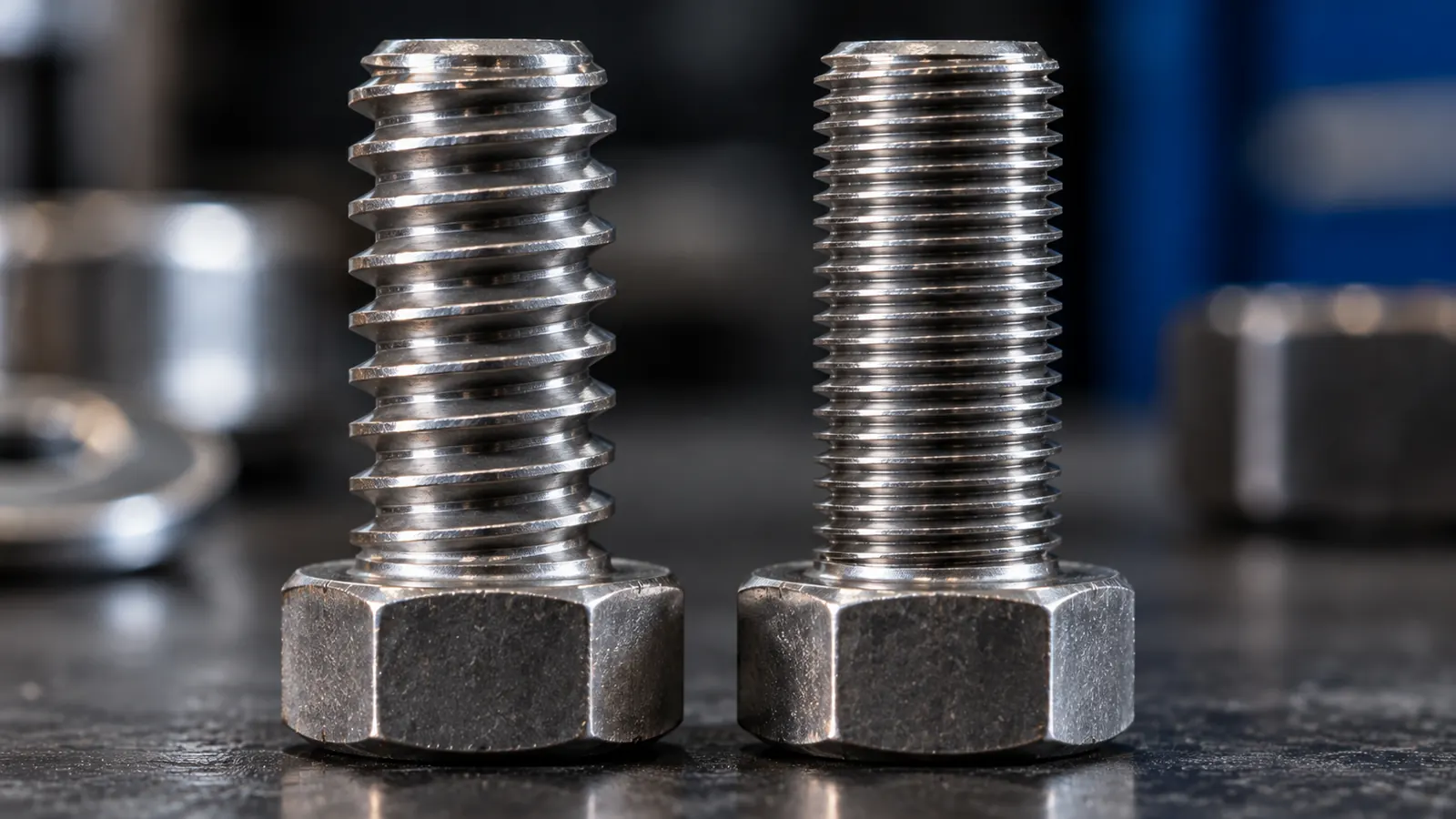
UNC is the Unified coarse thread series and UNF the fine series, both 60° threads defined in ASME B1.1. On the same diameter UNF has more threads per inch, for example 1/4-20 UNC and 1/4-28 UNF. Fine thread has a 9.5 to 14 % larger tensile stress area, so it is stronger in tension; coarse thread assembles faster and resists stripping better in soft materials.
Key takeaways
- UNC = Unified National Coarse, UNF = Unified National Fine, UNEF = Unified National Extra Fine; all use a 60° thread form.
- UNF tensile stress area is 9.5 to 14 % larger than UNC from 1/4 to 1 in, calculated with As = 0.7854 × (D − 0.9743/n)².
- Coarse thread is the default and is better in aluminum, cast iron and other weak tapped materials.
- Fine thread gives finer adjustment, a smaller lead angle and more threads in thin walls.
- UNC and UNF of the same diameter are not interchangeable.
UNC vs UNF: coarse vs fine thread
UNC (Unified National Coarse) has fewer, deeper threads per inch; UNF (Unified National Fine) has more, shallower threads on the same diameter. A 1/4 in bolt is 1/4-20 in UNC and 1/4-28 in UNF. Both use the same 60° thread form from ASME B1.1, so the only difference is pitch.
Coarse thread is the default for general assembly. Fine thread is chosen when you need more tensile strength from the same diameter, finer adjustment or more threads in a thin wall. The two series cannot be mixed: a UNC bolt will not thread into a UNF hole of the same diameter.
- UNC: coarse series. The standard for bolts, cap screws and tapped holes in steel, cast iron and aluminum.
- UNF: fine series. Automotive and aircraft fasteners, adjusting screws, thin sections.
- UNEF: extra fine series. Thin-wall tubing, instrument and optical parts, short engagement lengths. 1/4-32 and 1/2-28 are UNEF.
- UNRC / UNRF: the same coarse and fine threads with a rounded root on the external thread. Rolled bolts are usually made this way, and they fit standard UNC and UNF nuts.
UNC UNF thread chart
Every UNC and UNF size from ASME B1.1, side by side, with the tap drill in brackets. Number sizes have a major diameter of 0.060 in + 0.013 in × the number.
| Size | Major dia (in) | UNC thread (tap drill) | UNF thread (tap drill) |
|---|---|---|---|
| #0 | 0.060 | — | #0-80 (3/64) |
| #1 | 0.073 | #1-64 (#53) | #1-72 (#53) |
| #2 | 0.086 | #2-56 (#50) | #2-64 (#50) |
| #3 | 0.099 | #3-48 (#47) | #3-56 (#45) |
| #4 | 0.112 | #4-40 (#43) | #4-48 (#42) |
| #5 | 0.125 | #5-40 (#38) | #5-44 (#37) |
| #6 | 0.138 | #6-32 (#36) | #6-40 (#33) |
| #8 | 0.164 | #8-32 (#29) | #8-36 (#29) |
| #10 | 0.190 | #10-24 (#25) | #10-32 (#21) |
| #12 | 0.216 | #12-24 (#16) | #12-28 (#14) |
Fractional sizes from 1/4 to 1 in, with the tensile stress area of each series calculated from As = 0.7854 × (D − 0.9743 ÷ n)², where D is the major diameter and n is threads per inch. The torque column is the site's grade 5 dry value, 75 % of proof load with K = 0.20.
| Size | UNC | UNF | UNC stress area (in²) | UNF stress area (in²) | UNF gain | Grade 5 dry torque UNC / UNF (ft-lb) |
|---|---|---|---|---|---|---|
| 1/4 | 1/4-20 | 1/4-28 | 0.0318 | 0.0364 | +14.3 % | 8.5 / 9.7 |
| 5/16 | 5/16-18 | 5/16-24 | 0.0524 | 0.0581 | +10.7 % | 17.4 / 19.3 |
| 3/8 | 3/8-16 | 3/8-24 | 0.0775 | 0.0878 | +13.3 % | 31 / 35 |
| 7/16 | 7/16-14 | 7/16-20 | 0.1063 | 0.1187 | +11.7 % | 49 / 55 |
| 1/2 | 1/2-13 | 1/2-20 | 0.1419 | 0.1600 | +12.7 % | 75 / 85 |
| 9/16 | 9/16-12 | 9/16-18 | 0.1819 | 0.2030 | +11.6 % | 109 / 121 |
| 5/8 | 5/8-11 | 5/8-18 | 0.2260 | 0.2560 | +13.3 % | 150 / 170 |
| 3/4 | 3/4-10 | 3/4-16 | 0.3345 | 0.3730 | +11.5 % | 267 / 297 |
| 7/8 | 7/8-9 | 7/8-14 | 0.4617 | 0.5095 | +10.3 % | 429 / 474 |
| 1 | 1-8 | 1-12 | 0.6057 | 0.6630 | +9.5 % | 644 / 704 |
Commonly searched fine threads: 3/8 fine thread is 3/8-24, 7/16 fine is 7/16-20, 1/2 fine is 1/2-20, 5/8 fine is 5/8-18, 3/4 fine is 3/4-16 and 7/8 fine is 7/8-14. The coarse versions are 3/8-16, 7/16-14, 1/2-13, 5/8-11, 3/4-10 and 7/8-9. Full torque tables are on the bolt torque chart, for example 1/2 in bolt torque.
Is fine thread stronger than coarse thread?
In tension, yes. A fine thread has a shallower groove, so more steel remains in the core. Across 1/4 to 1 in the UNF tensile stress area is 9.5 to 14.3 % larger than UNC, and the bolt's proof load rises by the same percentage.
Example, grade 8: a 1/4-20 UNC bolt has a stress area of 0.0318 in² and a proof load of 3,819 lbf. A 1/4-28 UNF bolt has 0.0364 in² and 4,365 lbf. At 1/2 in the figures are 17,028 lbf for 1/2-13 and 19,194 lbf for 1/2-20. Proof strength comes from SAE J429; see bolt grades and markings.
In stripping, the answer depends on the hole. Thread depth of the basic profile is 0.5413 × pitch: 0.0271 in for 1/4-20 against 0.0193 in for 1/4-28. In a soft or brittle tapped part such as aluminum or cast iron, the deeper coarse thread shears a larger section of the weaker material and resists stripping better. Where the nut or tapped part is as strong as the bolt, fine thread gives the higher joint strength.
When to use coarse vs fine thread
Use coarse thread unless there is a specific reason for fine. That keeps parts standard and available, and coarse threads are more forgiving in service.
Choose coarse thread (UNC, metric coarse) when
- The tapped part is aluminum, cast iron, brass, plastic or another material weaker than the bolt.
- Assembly is frequent or fast: a 1/4-20 screw goes in 1 in with 20 turns, a 1/4-28 needs 28.
- Threads may be dirty, damaged, painted or plated. Coarse threads start more easily and resist cross-threading.
- Parts are bought off the shelf: hardware stock is mostly coarse.
Choose fine thread (UNF, metric fine) when
- You need maximum tensile strength from a given diameter, for example high-strength studs and connecting-rod bolts.
- The wall is thin, so a shallow thread fits and more threads engage in the same length.
- Fine adjustment matters: one turn of 1/4-28 moves 0.036 in, one turn of 1/4-20 moves 0.050 in.
- Vibration is a concern. The lead angle of 1/4-28 is 2.9° against 4.2° for 1/4-20, so less of the clamp load turns into loosening torque. Preload and a proper locking method matter more than the pitch.
- The tapped material is hard. A fine tap removes less material per thread and is less likely to break in hardened steel.
Fine threads have a smaller tap drill and less thread height, so thread engagement length should be checked in soft materials. The thread percentage calculator shows how much thread a given drill leaves.
Metric coarse vs fine thread
Metric threads follow the same logic. ISO coarse is the default and is written without a pitch (M12 means M12 × 1.75). Fine threads state the pitch: M12 × 1.5 or M12 × 1.25.
| Size | Coarse | Fine | Coarse stress area (mm²) | Fine stress area (mm²) | Fine gain |
|---|---|---|---|---|---|
| M6 | M6 × 1 | M6 × 0.75 | 20.1 | 22.0 | +9.5 % |
| M8 | M8 × 1.25 | M8 × 1 | 36.6 | 39.2 | +7.0 % |
| M10 | M10 × 1.5 | M10 × 1 | 58.0 | 64.5 | +11.2 % |
| M10 | M10 × 1.5 | M10 × 1.25 | 58.0 | 61.2 | +5.5 % |
| M12 | M12 × 1.75 | M12 × 1.25 | 84.3 | 92.1 | +9.3 % |
| M12 | M12 × 1.75 | M12 × 1.5 | 84.3 | 88.1 | +4.6 % |
| M14 | M14 × 2 | M14 × 1.5 | 115.4 | 124.5 | +7.9 % |
| M16 | M16 × 2 | M16 × 1.5 | 156.7 | 167.2 | +6.8 % |
| M18 | M18 × 2.5 | M18 × 1.5 | 192.5 | 216.2 | +12.3 % |
| M20 | M20 × 2.5 | M20 × 1.5 | 244.8 | 271.5 | +10.9 % |
| M22 | M22 × 2.5 | M22 × 1.5 | 303.4 | 333.1 | +9.8 % |
| M24 | M24 × 3 | M24 × 2 | 352.5 | 384.4 | +9.1 % |
| M27 | M27 × 3 | M27 × 2 | 459.4 | 495.7 | +7.9 % |
| M30 | M30 × 3.5 | M30 × 2 | 560.6 | 621.2 | +10.8 % |
Stress areas from As = π/4 × (d − 0.9382 × P)². The gain for metric fine threads is often smaller than for UNF, because several metric fine pitches are only one step finer than coarse, for example M10 × 1.25 against M10 × 1.5. M12 fine thread is usually M12 × 1.5 or M12 × 1.25; automotive wheel studs commonly use one of the two.
Metric and inch fine threads are not interchangeable even where the pitch is close; see metric vs imperial threads.
How to tell UNC from UNF
Measure the diameter, then count threads per inch with a pitch gauge or a rule. Same diameter, more threads per inch means fine. A 1/4 in bolt with 20 threads per inch is UNC; with 28 it is UNF. Head markings show the grade, not the thread series.
A quick shop check is to try a known nut: a UNC nut runs freely down a UNC bolt and stops after a turn on a UNF bolt. The full method is in how to measure thread pitch, and all diameters and pitches are on the thread pitch chart.
A callout such as 1/2-13 UNC-2B means 1/2 in, 13 TPI, coarse series, class 2B internal thread. Class 2A and 2B are the normal commercial fit; thread classes and fits explains 1A to 3B.
Sources and standards
- ASME B1.1, Unified inch screw threads (UN and UNR thread form)
- ISO 898-1, Mechanical properties of fasteners made of carbon steel and alloy steel
- SAE J429, Mechanical and material requirements for externally threaded fasteners
- ISO 261
General reference information. When a manufacturer, drawing or governing standard gives a value, that value takes precedence.
Related charts and guides
Common questions
What does UNC mean for threads?
UNC stands for Unified National Coarse, the coarse-pitch series of the Unified inch screw thread standard, ASME B1.1. It has a 60° thread angle. Common UNC sizes are #10-24, 1/4-20, 5/16-18, 3/8-16 and 1/2-13, where the second number is threads per inch. It is the default thread for inch bolts and tapped holes.
What are UNF threads?
UNF threads are the Unified National Fine series from ASME B1.1. They have the same 60° form as UNC but more threads per inch on each diameter, for example 1/4-28, 5/16-24, 3/8-24 and 1/2-20. They give a larger tensile stress area and finer adjustment and are common on automotive and aircraft fasteners.
Is fine thread stronger than coarse thread?
In tension, yes. From 1/4 to 1 in the UNF tensile stress area is 9.5 to 14 % larger than UNC, so the proof load is higher by the same amount. A grade 8 1/4-28 bolt holds about 4,370 lbf at proof, a 1/4-20 about 3,820 lbf. In a soft tapped material such as aluminum, coarse thread resists stripping better.
What is 3/8 fine thread?
3/8 fine thread is 3/8-24 UNF: 0.375 in major diameter and 24 threads per inch, a pitch of 1.058 mm. The tap drill is Q (0.332 in). The coarse version is 3/8-16 UNC with a 5/16 in tap drill. The two are not interchangeable.
What is 1/2 fine thread?
1/2 fine thread is 1/2-20 UNF: 0.500 in major diameter and 20 threads per inch. The tap drill is 29/64 in. The coarse version is 1/2-13 UNC with a 27/64 in tap drill. The UNF stress area is about 0.160 in² against 0.142 in² for UNC.
When should you use fine thread bolts?
Use fine thread when you need the most tensile strength from a given diameter, fine adjustment, or more threads in a thin wall, and when tapping hard steel. Use coarse thread for general assembly, frequent assembly, dirty or plated threads, and holes tapped in aluminum, cast iron or plastic.
What is the metric fine thread for M12?
M12 fine thread is M12 × 1.5 or M12 × 1.25; the coarse thread is M12 × 1.75. Tap drills are 10.5 mm for M12 × 1.5 and 10.8 mm for M12 × 1.25. The tensile stress area rises from 84.3 mm² for coarse to 88.1 mm² and 92.1 mm².