Bolt grades and head markings
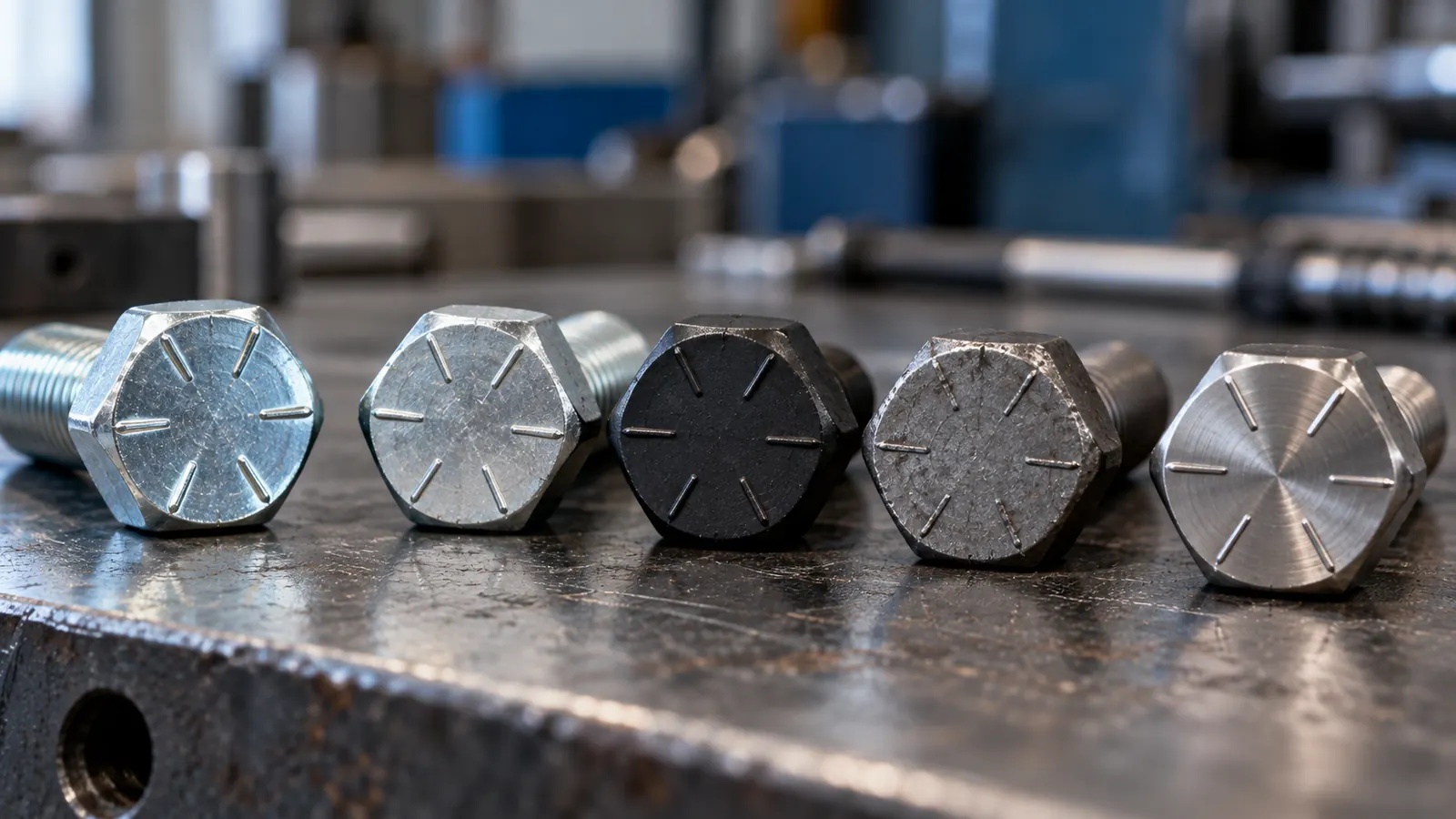
Bolt grades rate bolt strength. Inch bolts use SAE grades: no head marks is grade 2, 3 radial lines is grade 5 (120,000 psi tensile) and 6 lines is grade 8 (150,000 psi). Metric bolts are stamped with a class: 8.8 means 800 MPa nominal tensile and 640 MPa yield; 10.9 and 12.9 are stronger.
Key takeaways
- SAE head markings: no lines is grade 2, 3 radial lines grade 5, 6 radial lines grade 8.
- Metric 8.8 means 800 MPa nominal tensile strength and a yield of 0.8 × 800 = 640 MPa.
- Class 8.8 is roughly comparable to grade 5, and class 10.9 to grade 8.
- Use a nut of the same or higher class: class 8 nut with 8.8, class 10 with 10.9.
- A2-70 stainless has 700 MPa tensile but only 450 MPa yield, below class 8.8.
What are bolt grades?
Bolt grades are strength ratings for bolts. Inch bolts use SAE J429 grades (2, 5 and 8, identified by radial lines on the head) and metric bolts use ISO 898-1 property classes (4.6, 8.8, 10.9 and 12.9, stamped as numbers on the head). A higher grade or class means a stronger, harder bolt.
The grade tells you three numbers: the proof strength (the load the bolt carries with no permanent stretch), the yield strength and the minimum tensile strength. Proof strength sets the tightening torque, which is why every row on the bolt torque chart is split by grade.
Bolt grade markings: how to tell what grade a bolt is
To tell what grade an inch bolt is, count the radial lines on the head: no lines is grade 2, 3 lines is grade 5 and 6 lines is grade 8. The grade number is always two more than the number of lines. Metric bolts carry the class number itself, such as 8.8 or 10.9, on the head.
SAE bolt grade chart
| SAE J429 grade | Head marking | Material | Proof strength (psi) | Min. yield (psi) | Min. tensile (psi) | Hardness (Rockwell) |
|---|---|---|---|---|---|---|
| Grade 2 | No marks | Low or medium carbon steel | 55,000 | 57,000 (to 3/4 in) | 74,000 | B80–B100 (to 3/4 in) |
| Grade 5 | 3 radial lines | Medium carbon steel, quenched and tempered | 85,000 | 92,000 (to 1 in) | 120,000 | C25–C34 |
| Grade 8 | 6 radial lines | Medium carbon alloy steel, quenched and tempered | 120,000 | 130,000 | 150,000 | C33–C39 |
Strength values are SAE J429 minimums for sizes 1/4 to 3/4 in (grade 2), 1/4 to 1 in (grade 5) and 1/4 to 1-1/2 in (grade 8). Above 3/4 in, grade 2 drops to 33,000 psi proof and 60,000 psi tensile. Above 1 in, grade 5 drops to 74,000 psi proof and 105,000 psi tensile.
Metric bolt head markings
ISO 898-1 requires the property class to be marked on hex bolts and socket head cap screws from M5 upward, together with the maker's identification mark. The numbers are raised or indented on the top of the head; on socket head cap screws they are often on the side of the head. A bolt marked only with a maker's mark and no class is not a verified high-strength bolt.
Other head markings you will see
- 307A or A307: ASTM A307 Grade A, a low carbon steel bolt with 60,000 psi minimum tensile strength, for general, non-critical use.
- A325: high-strength structural bolt (now covered by ASTM F3125), 120,000 psi minimum tensile strength.
- A490: higher-strength structural bolt, 150,000 psi minimum tensile strength. Not to be galvanized.
- B7: ASTM A193 grade B7 alloy steel studs for pressure flanges, normally used with nuts marked 2H (ASTM A194).
- A2-70, A4-80: stainless steel bolts to ISO 3506-1, explained below.
Metric bolt grades: what 8.8, 10.9 and 12.9 mean
The metric class number encodes the strength. In 8.8, the first 8 means a nominal tensile strength of 8 × 100 = 800 MPa, and the .8 means the yield strength is 0.8 times that, or 640 MPa. Class 10.9 means 1000 MPa nominal tensile and 0.9 × 1000 = 900 MPa nominal yield; 12.9 means 1200 MPa and 1080 MPa.
The nominal numbers are a code. The actual ISO 898-1 minimums are slightly higher for tensile strength:
| ISO 898-1 class | Head marking | Material | Proof stress (MPa) | Min. yield (MPa) | Min. tensile (MPa) | Hardness |
|---|---|---|---|---|---|---|
| 4.6 | 4.6 (often unmarked on small sizes) | Low or medium carbon steel | 225 | 240 | 400 | — |
| 8.8 | 8.8 | Medium carbon steel, quenched and tempered | 580 (≤ M16), 600 (> M16) | 640 (≤ M16), 660 (> M16) | 800 (≤ M16), 830 (> M16) | HRC 22–32 (≤ M16) |
| 10.9 | 10.9 | Alloy or boron steel, quenched and tempered | 830 | 940 | 1040 | HRC 32–39 |
| 12.9 | 12.9 | Alloy steel, quenched and tempered | 970 | 1100 | 1220 | HRC 39–44 |
Class 8.8 is the general-purpose metric high-strength bolt and is roughly comparable to SAE grade 5. Class 10.9 is roughly comparable to SAE grade 8. Class 12.9 is the usual class for alloy steel socket head cap screws. The comparison is approximate; do not substitute one system for the other on a critical joint without checking the numbers.
8.8 vs 10.9 vs 12.9 bolts
Class 10.9 has about 43 % more proof strength than 8.8 at sizes to M16 (830 vs 580 MPa), and 12.9 about 67 % more (970 MPa). For an M12 × 1.75 bolt, the proof load is 48.9 kN in 8.8, 69.9 kN in 10.9 and 81.7 kN in 12.9.
| Property | 8.8 | 10.9 | 12.9 |
|---|---|---|---|
| M12 proof load | 48.9 kN | 69.9 kN | 81.7 kN |
| M12 dry torque (K 0.20, 75 % proof) | 88 N·m | 126 N·m | 147 N·m |
| Typical use | General machinery, structures, vehicles | Higher-load machinery, vehicle chassis | Socket head cap screws, tooling, dies |
| Ductility | Highest | Lower | Lowest |
| Hydrogen embrittlement risk if electroplated | Low | Higher | Highest; usually supplied black oxide or oiled |
Stronger is not always better. Higher classes are harder and less ductile, so they give less warning before fracture and are more sensitive to hydrogen embrittlement from electroplating and to corrosion cracking. Use the class the design calls for. If you upgrade a bolt, the nut, the thread engagement and the clamped parts must also carry the higher load; see thread engagement length.
What is the strongest bolt grade?
Among standard grades, metric class 12.9 (1220 MPa minimum tensile) and SAE grade 8 (150,000 psi, about 1034 MPa) are the strongest common bolts. Some makers sell proprietary grades above these, but they are not covered by SAE J429 or ISO 898-1.
Bolt strength chart: proof load and tensile load
Proof load and minimum tensile (breaking) load are calculated as stress × tensile stress area, from ISO 898-1 and SAE J429 values. Coarse threads.
Metric bolts
| Size | 8.8 proof / tensile (kN) | 10.9 proof / tensile (kN) | 12.9 proof / tensile (kN) |
|---|---|---|---|
| M4 × 0.7 | 5.1 / 7.0 | 7.3 / 9.1 | 8.5 / 10.7 |
| M5 × 0.8 | 8.2 / 11.3 | 11.8 / 14.7 | 13.8 / 17.3 |
| M6 × 1 | 11.7 / 16.1 | 16.7 / 20.9 | 19.5 / 24.6 |
| M8 × 1.25 | 21.2 / 29.3 | 30.4 / 38.1 | 35.5 / 44.7 |
| M10 × 1.5 | 33.6 / 46.4 | 48.1 / 60.3 | 56.2 / 70.7 |
| M12 × 1.75 | 48.9 / 67.4 | 69.9 / 87.6 | 81.7 / 102.8 |
| M14 × 2 | 67.0 / 92.4 | 95.8 / 120.1 | 112.0 / 140.8 |
| M16 × 2 | 90.9 / 125.3 | 130.0 / 162.9 | 152.0 / 191.1 |
| M18 × 2.5 | 115.5 / 159.8 | 159.8 / 200.2 | 186.7 / 234.8 |
| M20 × 2.5 | 146.9 / 203.2 | 203.2 / 254.6 | 237.5 / 298.6 |
| M22 × 2.5 | 182.0 / 251.8 | 251.8 / 315.5 | 294.3 / 370.1 |
| M24 × 3 | 211.5 / 292.6 | 292.6 / 366.6 | 341.9 / 430.1 |
| M27 × 3 | 275.6 / 381.3 | 381.3 / 477.8 | 445.6 / 560.5 |
| M30 × 3.5 | 336.4 / 465.3 | 465.3 / 583.0 | 543.8 / 683.9 |
| M33 × 3.5 | 416.1 / 575.6 | 575.6 / 721.3 | 672.7 / 846.1 |
| M36 × 4 | 490.0 / 677.9 | 677.9 / 849.4 | 792.2 / 996.4 |
SAE bolts
| Size (UNC) | Grade 2 proof / tensile (lbf) | Grade 5 proof / tensile (lbf) | Grade 8 proof / tensile (lbf) |
|---|---|---|---|
| 1/4-20 | 1,750 / 2,355 | 2,705 / 3,819 | 3,819 / 4,773 |
| 5/16-18 | 2,884 / 3,880 | 4,457 / 6,292 | 6,292 / 7,865 |
| 3/8-16 | 4,262 / 5,734 | 6,587 / 9,299 | 9,299 / 11,623 |
| 7/16-14 | 5,847 / 7,867 | 9,036 / 12,757 | 12,757 / 15,946 |
| 1/2-13 | 7,804 / 10,501 | 12,061 / 17,028 | 17,028 / 21,285 |
| 9/16-12 | 10,007 / 13,464 | 15,465 / 21,833 | 21,833 / 27,292 |
| 5/8-11 | 12,430 / 16,724 | 19,210 / 27,120 | 27,120 / 33,900 |
| 3/4-10 | 18,395 / 24,750 | 28,429 / 40,135 | 40,135 / 50,169 |
| 7/8-9 | 15,237 / 27,704 | 39,247 / 55,408 | 55,408 / 69,260 |
| 1-8 | 19,990 / 36,345 | 51,488 / 72,689 | 72,689 / 90,862 |
Grade 8 bolt strength
A grade 8 bolt has 120,000 psi proof strength, 130,000 psi yield and 150,000 psi minimum tensile strength. A 1/2-13 grade 8 bolt therefore has a proof load of 17,028 lbf and a minimum tensile load of 21,285 lbf.
Shear strength of bolts
The ultimate shear strength of a steel bolt is commonly estimated at about 60 % of its tensile strength. Use the root area when the threads are in the shear plane and the shank area when they are not. Bolted joints are designed so friction from preload carries shear where possible; see bolt preload and clamp load.
Nut grades and classes
A nut must be the same grade or class as the bolt, or higher. Use a class 8 nut with an 8.8 bolt, class 10 with 10.9 and class 12 with 12.9 (ISO 898-2), and a grade 5 nut with a grade 5 bolt, grade 8 with grade 8 (SAE J995).
The nut is designed so the bolt breaks before the nut threads strip, which gives a visible failure instead of a hidden one. A lower-grade nut on a high-grade bolt can strip during tightening at the bolt's full torque. Metric nuts carry the class number on a face or flat; inch nuts use marks on the face or corners. Check the maker's marking chart for inch nuts, because the systems vary between makers.
Stainless steel bolt markings: A2 and A4
Stainless steel bolts are marked with a steel group and a strength class, such as A2-70: A2 is austenitic stainless similar to 304 and A4 is austenitic stainless with molybdenum, similar to 316. The number after the dash is one tenth of the minimum tensile strength in MPa.
| ISO 3506-1 marking | Similar alloy | Min. tensile (MPa) | Min. yield Rp0.2 (MPa) |
|---|---|---|---|
| A2-50 | 304 | 500 | 210 |
| A2-70 | 304 | 700 | 450 |
| A4-70 | 316 | 700 | 450 |
| A4-80 | 316 | 800 | 600 |
A2-70 has a yield strength well below class 8.8 (450 vs 640 MPa), so stainless bolts are not a direct strength replacement for carbon steel bolts. Choose A4 for marine and chloride exposure; see 304 vs 316 stainless steel. Stainless threads gall easily, so use anti-seize and a reduced torque.
Bolt sizes and wrench sizes are listed in the bolt and wrench size chart, and torque for each grade is in the bolt torque calculator and on pages such as M8, M10, 3/8 in and 1/2 in.
Sources and standards
- SAE J429, Mechanical and material requirements for externally threaded fasteners
- ISO 898-1, Mechanical properties of fasteners made of carbon steel and alloy steel
- ISO 898-2
- SAE J995
- ISO 3506-1
- ASTM A307
- ASTM F3125
- ASTM A193
- ASTM A194
General reference information. When a manufacturer, drawing or governing standard gives a value, that value takes precedence.
Related charts and guides
Common questions
How do you tell what grade a bolt is?
Look at the head. Inch bolts show radial lines: none for grade 2, three for grade 5 and six for grade 8, so the grade is the number of lines plus two. Metric bolts are stamped with the property class, such as 8.8, 10.9 or 12.9, along with the maker's mark.
What is a grade 8 bolt?
A grade 8 bolt is an SAE J429 medium carbon alloy steel bolt, quenched and tempered, marked with six radial lines on the head. It has 120,000 psi proof strength, 130,000 psi yield and 150,000 psi minimum tensile strength. A 1/2-13 grade 8 bolt breaks at no less than about 21,285 lbf.
What does 8.8 mean on a bolt?
8.8 is a metric property class under ISO 898-1. The first 8 means a nominal tensile strength of 800 MPa and the .8 means yield is 80 % of that, 640 MPa. The actual minimum tensile strength is 800 MPa up to M16 and 830 MPa above, with a proof stress of 580 or 600 MPa.
Is 10.9 stronger than grade 8?
They are close. Metric class 10.9 has a minimum tensile strength of 1040 MPa and grade 8 has 150,000 psi, about 1034 MPa. Proof stress is 830 MPa for 10.9 and 120,000 psi, about 827 MPa, for grade 8. The two are roughly equivalent, but always check the specified grade before substituting.
What is the strongest bolt grade?
Among standard bolt grades, metric class 12.9 is the strongest common one, with 1220 MPa minimum tensile strength and 970 MPa proof stress. SAE grade 8 at 150,000 psi tensile is the strongest common inch grade. Higher-strength proprietary bolts exist but are outside ISO 898-1 and SAE J429.
What is a 307A bolt grade?
307A refers to ASTM A307 Grade A, a low carbon steel bolt with a minimum tensile strength of 60,000 psi, used for general, non-structural connections. It is weaker than SAE grade 5 and much weaker than structural A325 or A490 bolts, which have 120,000 and 150,000 psi minimum tensile strength.
What do A2-70 and A4-80 mean on stainless bolts?
Under ISO 3506-1, A2 is austenitic stainless similar to 304 and A4 is molybdenum-bearing austenitic stainless similar to 316. The number after the dash is one tenth of the minimum tensile strength in MPa: A2-70 is 700 MPa with 450 MPa yield, and A4-80 is 800 MPa with 600 MPa yield.