Bolt preload and clamp load explained
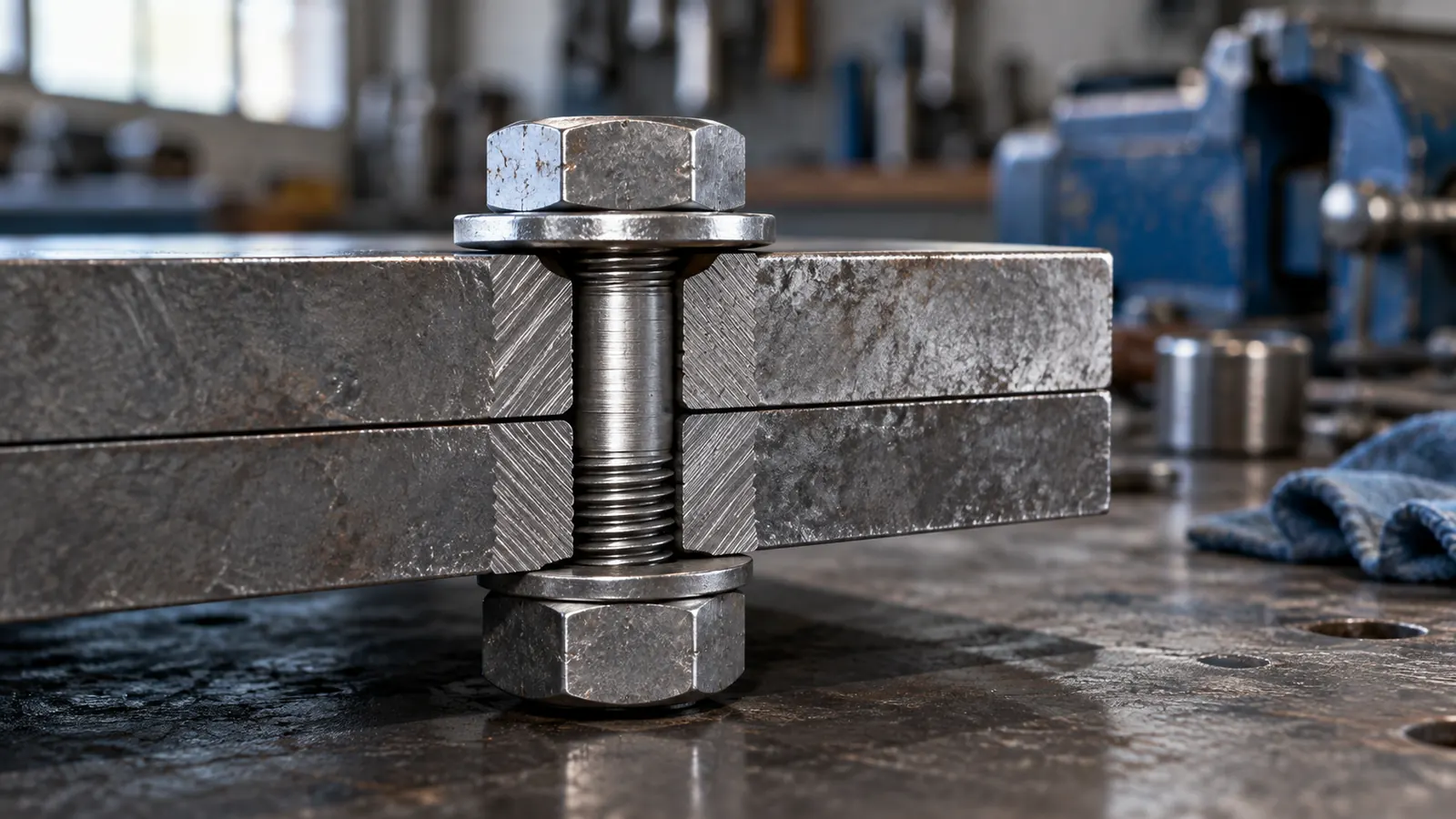
Bolt preload is the tension in a bolt after tightening; it creates the clamp load that holds the joint together. The usual target is 75 % of proof load. An M10 class 8.8 bolt has a proof load of 33.6 kN, so its target preload is 25.2 kN, reached with about 50 N·m dry.
Key takeaways
- Preload is the bolt tension after tightening; with no external load it equals the clamp load on the joint.
- Proof load = proof stress × tensile stress area; M10 8.8 is 33.6 kN.
- Target 75 % of proof load for reusable bolts and 90 % for permanent joints.
- Torque control gives preload scatter of ±25 % or more because about 90 % of torque goes to friction.
- Oiling a bolt without reducing torque can push preload to its full proof load.
What is bolt preload?
Bolt preload is the tension created in a bolt when it is tightened, before any working load is applied. The bolt stretches like a stiff spring, and that tension pulls the joint together. A typical target is 75 % of the bolt's proof load.
Preload is the reason bolts work. A properly preloaded bolt holds the joint parts so tightly that external loads mostly reduce the clamping pressure between the parts instead of adding to the bolt's own load. The bolt sees only a small change in tension each load cycle, which is what gives bolted joints good fatigue life and keeps nuts from vibrating loose.
Preload definition and the terms around it
- Preload (pretension, bolt tension): the axial tensile force in the bolt after tightening, in kN or lbf.
- Clamp load (clamping force): the compressive force the bolt exerts on the joint. With no external load, clamp load equals preload. With an external tensile load, clamp load drops while bolt tension rises slightly.
- Proof load: the highest tensile force a bolt can carry without measurable permanent stretch. It equals proof stress × tensile stress area.
- Tensile stress area (As): the effective cross-section of the threaded part, used for all strength calculations.
- Preloaded: in general engineering, a part that is loaded on assembly, before service loads, so it behaves stiffly in use. Preloaded bearings and preloaded bolts work on the same idea.
Proof load and tensile stress area
Proof load = proof stress × tensile stress area. For an M10 × 1.5 class 8.8 bolt that is 580 MPa × 58.0 mm² = 33.6 kN.
The tensile stress area comes from the thread geometry, not the nominal diameter, because the threads remove material. For metric threads (ISO 898-1, based on ISO 724), As = π/4 × (d − 0.9382 p)², where d is the nominal diameter and p the pitch. For inch threads (ASME B1.1), As = 0.7854 × (D − 0.9743 ÷ n)², where n is threads per inch. An M10 bolt's stress area of 58.0 mm² is about 74 % of the full 10 mm circle (78.5 mm²).
Proof stress sits just below yield. ISO 898-1 sets these minimums for the common property classes:
| Property class | Proof stress Sp (MPa) | Min. yield Rp0.2 (MPa) | Min. tensile Rm (MPa) |
|---|---|---|---|
| 8.8 | 580 (≤ M16), 600 (> M16) | 640 (660 above M16) | 800 (≤ M16), 830 (> M16) |
| 10.9 | 830 | 940 | 1040 |
| 12.9 | 970 | 1100 | 1220 |
Proof stress is about 88 % to 91 % of minimum yield for these metric classes. SAE J429 grade 5 (85,000 psi proof, 92,000 psi yield) and grade 8 (120,000 psi proof, 130,000 psi yield) sit at about 92 %. Head markings for each class and grade are shown in bolt grades and markings.
Bolt preload and proof load chart
Each cell shows proof load, then the 75 % preload target. Values are calculated from the ISO 898-1 proof stress and the ISO 724 stress area, coarse thread.
Metric bolts, class 8.8, 10.9 and 12.9
| Size | As (mm²) | Class 8.8 proof / preload (kN) | Class 10.9 proof / preload (kN) | Class 12.9 proof / preload (kN) |
|---|---|---|---|---|
| M4 × 0.7 | 8.8 | 5.1 / 3.8 | 7.3 / 5.5 | 8.5 / 6.4 |
| M5 × 0.8 | 14.2 | 8.2 / 6.2 | 11.8 / 8.8 | 13.8 / 10.3 |
| M6 × 1 | 20.1 | 11.7 / 8.8 | 16.7 / 12.5 | 19.5 / 14.6 |
| M8 × 1.25 | 36.6 | 21.2 / 15.9 | 30.4 / 22.8 | 35.5 / 26.6 |
| M10 × 1.5 | 58.0 | 33.6 / 25.2 | 48.1 / 36.1 | 56.2 / 42.2 |
| M12 × 1.75 | 84.3 | 48.9 / 36.7 | 69.9 / 52.5 | 81.7 / 61.3 |
| M14 × 2 | 115.4 | 67.0 / 50.2 | 95.8 / 71.9 | 112.0 / 84.0 |
| M16 × 2 | 156.7 | 90.9 / 68.2 | 130.0 / 97.5 | 152.0 / 114.0 |
| M18 × 2.5 | 192.5 | 115.5 / 86.6 | 159.8 / 119.8 | 186.7 / 140.0 |
| M20 × 2.5 | 244.8 | 146.9 / 110.2 | 203.2 / 152.4 | 237.5 / 178.1 |
| M22 × 2.5 | 303.4 | 182.0 / 136.5 | 251.8 / 188.9 | 294.3 / 220.7 |
| M24 × 3 | 352.5 | 211.5 / 158.6 | 292.6 / 219.4 | 341.9 / 256.4 |
| M27 × 3 | 459.4 | 275.6 / 206.7 | 381.3 / 286.0 | 445.6 / 334.2 |
| M30 × 3.5 | 560.6 | 336.4 / 252.3 | 465.3 / 349.0 | 543.8 / 407.8 |
| M33 × 3.5 | 693.6 | 416.1 / 312.1 | 575.6 / 431.7 | 672.7 / 504.6 |
| M36 × 4 | 816.7 | 490.0 / 367.5 | 677.9 / 508.4 | 792.2 / 594.2 |
Inch bolts, SAE grade 5 and grade 8, UNC
| Size (UNC) | As (in²) | Grade 5 proof / preload (lbf) | Grade 8 proof / preload (lbf) |
|---|---|---|---|
| 1/4-20 | 0.0318 | 2,705 / 2,029 | 3,819 / 2,864 |
| 5/16-18 | 0.0524 | 4,457 / 3,342 | 6,292 / 4,719 |
| 3/8-16 | 0.0775 | 6,587 / 4,940 | 9,299 / 6,974 |
| 7/16-14 | 0.1063 | 9,036 / 6,777 | 12,757 / 9,568 |
| 1/2-13 | 0.1419 | 12,061 / 9,046 | 17,028 / 12,771 |
| 9/16-12 | 0.1819 | 15,465 / 11,599 | 21,833 / 16,375 |
| 5/8-11 | 0.2260 | 19,210 / 14,408 | 27,120 / 20,340 |
| 3/4-10 | 0.3345 | 28,429 / 21,322 | 40,135 / 30,101 |
| 7/8-9 | 0.4617 | 39,247 / 29,436 | 55,408 / 41,556 |
| 1-8 | 0.6057 | 51,488 / 38,616 | 72,689 / 54,517 |
Fine threads have a larger stress area and therefore a higher proof load at the same diameter. The tightening torque that produces each preload is on the bolt torque chart, or you can set a custom preload percentage in the bolt torque calculator.
The 75 % rule: how much preload to use
The common rule is to preload reusable bolts to 75 % of proof load, and permanent connections to 90 % of proof load. Shigley's Mechanical Engineering Design gives these two figures, and most published torque charts, including this site's, use 75 %.
Why not tighten to 100 %? Three reasons. First, torque tightening scatters by ±25 % or more, so aiming at 75 % keeps the high side of the scatter below yield. Second, tightening adds torsional stress from thread friction, so the bolt is under combined stress during tightening and is closer to yield than the axial figure suggests. Third, the joint needs margin for the extra bolt load that external forces add in service.
Why not tighten much less? A low preload lets the joint separate or slip under load. Once the joint opens, the bolt carries the full alternating load and fatigue failure follows quickly. Low preload is the most common cause of bolt fatigue and self-loosening.
Clamping force formula
The clamping force from a known tightening torque is F = T ÷ (K × d), the rearranged bolt torque formula. For an M10 bolt tightened dry (K 0.20) to 50 N·m: F = 50 ÷ (0.20 × 0.010 m) = 25.0 kN. For an M16 class 10.9 bolt the 75 % target is 97.5 kN; for a 1/2-13 grade 8 bolt it is 12,771 lbf.
Why torque is a poor proxy for bolt tension
Torque does not measure preload; it only drives it, and roughly 90 % of the applied torque is lost to friction under the head and in the threads. Small changes in friction cause large changes in preload at the same torque.
Example: an M10 8.8 bolt with a dry torque of 50 N·m gives 25.2 kN at K 0.20. Oil the same bolt (K 0.15) and the same torque gives 33.6 kN, essentially the full proof load of 33.6 kN. With anti-seize (K about 0.11) it would demand 45.9 kN, which the bolt cannot carry without yielding.
What affects preload?
- Friction: lubricant, plating, thread finish, washer hardness and surface finish under the head.
- Tool accuracy: a click torque wrench is typically within ±4 % per ISO 6789; impact tools are far less consistent. See how to use a torque wrench.
- Embedment: surface roughness flattens in the first hours after tightening, so some preload is lost even in a perfect joint. Fewer interfaces and harder, smoother faces mean less loss.
- Gasket creep and relaxation: soft gaskets flow under load and lose preload over time.
- Elastic interaction: tightening one bolt on a flange partly unloads its neighbours. A correct bolt torque sequence with several passes evens this out.
- Temperature: different expansion rates of bolt and joint material change preload as the joint heats and cools, for example steel bolts in aluminum parts.
- Thread engagement: too few engaged threads strip before the bolt reaches proof load. See thread engagement length.
What increases or decreases preload?
At a fixed torque, preload increases when friction drops (lubricant, anti-seize, smooth hardened washers) and decreases when friction rises (dry, rusty or damaged threads, rough faces, galling). Over time, preload decreases with embedment, gasket creep, vibration and thermal cycling. It increases in service only if the joint material expands more than the bolt.
How clamp load carries external loads
When an external tensile load P pulls on a preloaded joint, the bolt tension rises by only a fraction of P, and the clamp load on the joint drops by the rest. The split depends on the stiffness of the bolt (kb) and the clamped parts (km).
The joint constant C = kb ÷ (kb + km). Bolt load = Fi + C × P, and clamp load on the parts = Fi − (1 − C) × P, where Fi is the preload. Because the clamped parts are usually much stiffer than the bolt, C is usually well below 0.5, so most of the external load is absorbed by the joint rather than the bolt.
The joint separates when (1 − C) × P exceeds the preload. After separation the bolt carries the entire external load, which is why adequate preload is the main design requirement for fatigue-loaded joints such as connecting rods, cylinder heads and wheel studs.
How to measure preload and bolt clamping force
Preload can be measured directly with a load cell, or indirectly from bolt stretch, nut rotation or torque. Roughly in order of increasing accuracy:
| Method | What is measured | Typical use |
|---|---|---|
| Torque control | Applied torque, converted with K | General assembly; scatter ±25 % or more |
| Torque-angle (turn-of-nut) | Rotation past a snug torque | Engine bolts, structural steel bolts |
| Direct tension indicators | Crushed bumps on a special washer (ASTM F959) | Structural steel connections |
| Bolt elongation | Stretch by micrometer or ultrasonic gauge | Connecting rods, critical machinery |
| Hydraulic bolt tensioning | Hydraulic pressure on a bolt stretcher | Large flanges, wind turbines, pressure vessels |
| Load cell or load washer | Force directly | Testing, calibration, research |
Bolt stretch formula
Elongation ΔL = F × L ÷ (A × E), with E about 205,000 MPa for steel. An M10 8.8 bolt at its 25.2 kN preload over a 40 mm effective length stretches about 0.085 mm, using the stress area as an approximation. Real calculations split the bolt into shank and thread sections, but the order of magnitude shows why elongation measurement needs a gauge that reads to 0.001 mm (0.0001 in).
A bolt stretcher (hydraulic tensioner) pulls the bolt axially with no torque friction, then the nut is run down by hand. Some load is lost when the tool releases, so tensioning procedures specify an overstretch factor from the tool maker.
Sources and standards
- ISO 898-1, Mechanical properties of fasteners made of carbon steel and alloy steel
- SAE J429, Mechanical and material requirements for externally threaded fasteners
- ISO 724, ISO general-purpose metric screw threads, basic dimensions
- ASME B1.1, Unified inch screw threads (UN and UNR thread form)
- ASTM F959
- Shigley's Mechanical Engineering Design
General reference information. When a manufacturer, drawing or governing standard gives a value, that value takes precedence.
Related charts and guides
Common questions
What is preload?
Preload is the tensile force in a bolt after it is tightened and before any working load is applied. The stretched bolt acts like a stiff spring and clamps the joint. For general bolts the target is 75 % of proof load, for example 25.2 kN for an M10 class 8.8 bolt.
What does preloaded mean?
Preloaded means a part has been loaded during assembly, before service loads arrive. A preloaded bolt is already in tension, so external loads mostly reduce the clamp pressure on the joint instead of adding to the bolt's load. Preloaded bearings use the same principle to remove internal clearance.
What is the difference between preload and clamp load?
Preload is the tension in the bolt; clamp load is the compression it puts on the joint. With no external load the two are equal. When an external tensile load is applied, bolt tension rises a little and clamp load falls, and the joint separates when clamp load reaches zero.
What affects bolt preload?
At a given torque, preload depends mainly on friction in the threads and under the head, which lubricant, plating and surface finish change. Tool accuracy, embedment of rough surfaces, gasket creep, temperature changes and the tightening sequence on multi-bolt joints also change the preload a bolt ends up with.
How do you calculate bolt clamping force?
Use F = T ÷ (K × d), where T is torque, K the nut factor and d the nominal diameter. An M10 bolt tightened dry (K 0.20) to 50 N·m gives about 25.0 kN. Because K scatters by ±25 % or more, the real clamping force can differ by the same amount.
How do you measure bolt preload?
Measure bolt elongation with a micrometer or ultrasonic gauge and convert it with ΔL = F × L ÷ (A × E), use direct tension indicator washers, control rotation with torque-angle tightening, or use a load cell. Torque alone only estimates preload, typically within ±25 % or worse.
Why are bolts tightened to 75 % of proof load?
75 % of proof load leaves margin for torque scatter, for the torsional stress added during tightening and for the extra load the joint sees in service, while still clamping hard enough to prevent separation and fatigue. Permanent joints are often tightened to 90 % of proof load.