Stainless steel grades explained: types, families and uses
Stainless steel grades are iron alloys with at least 10.5 % chromium, which forms a self-healing oxide film. They fall into five families: austenitic (304, 316, 303), ferritic (430), martensitic (410, 420, 440C), duplex (2205) and precipitation hardening (17-4PH). 304, about 18 % Cr and 8 % Ni, is the most common grade; 316 adds 2–3 % molybdenum for chloride resistance.
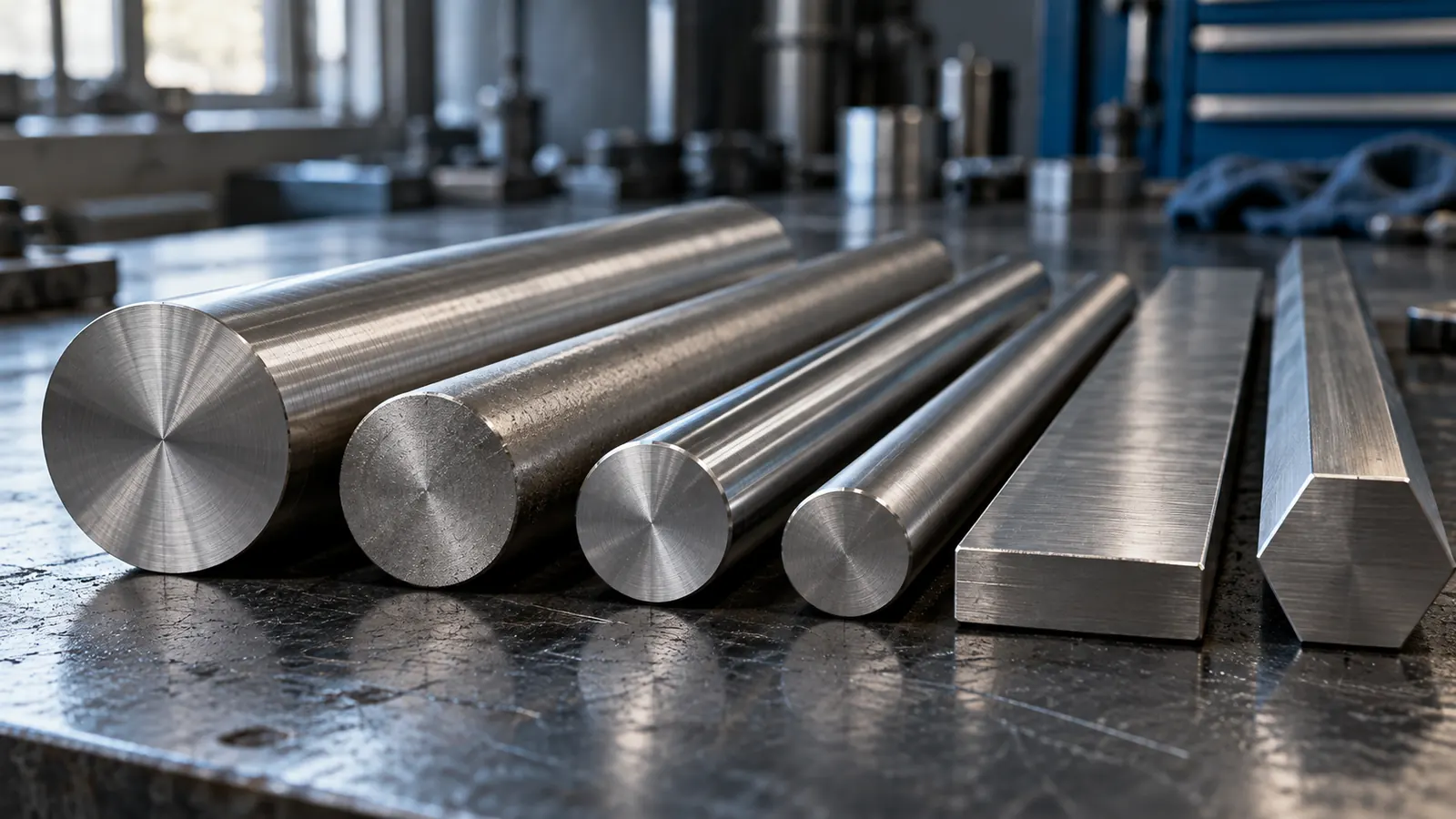
Key takeaways
- Stainless steel needs at least 10.5 % chromium; the chromium forms a passive oxide film that re-forms when scratched.
- The five families are austenitic, ferritic, martensitic, duplex and precipitation hardening.
- Annealed austenitic grades such as 304 and 316 are non-magnetic; 430, 410, 440C, 2205 and 17-4PH are magnetic.
- 18-8 means about 18 % chromium and 8 % nickel and covers 302, 303, 304 and 305, not one grade.
- 304 is UNS S30400, EN 1.4301 and JIS SUS304; these are nearest equivalents, not identical grades.
What are stainless steel grades?
Stainless steel grades are standardized alloys of iron with at least 10.5 % chromium, grouped into five families by their crystal structure: austenitic, ferritic, martensitic, duplex and precipitation hardening. The grade number, such as 304 or 430, fixes the allowed range of each alloying element.
The standards list many stainless grades, but a shop sees a short list again and again: 304 and 316 for general and corrosive service, 303 for machined parts, 430 for appliance sheet, 410, 420 and 440C for hardened parts, 17-4PH for high-strength parts and 2205 duplex for demanding chloride service. Each grade on this page links to its own steel grade equivalents page.
Stainless steel is a ferrous metal: it is mostly iron. Common stainless steel is not stronger than carbon steel by default. Annealed 304 has a minimum yield strength of 205 MPa (30 ksi) under ASTM A240, below the 250 MPa (36 ksi) minimum of A36 structural steel. Hardened martensitic, precipitation-hardening and duplex grades are much stronger.
What makes stainless steel stainless?
Chromium makes steel stainless. At 10.5 % chromium or more, the surface forms a thin, invisible chromium-oxide film, called the passive layer, that stops the iron underneath from rusting. If the film is scratched, it re-forms by itself in air or water that contains oxygen.
The 10.5 % minimum is the definition used by EN 10088-1, which also caps carbon at 1.2 %. Other elements adjust the properties:
- Nickel makes the structure austenitic: tough, ductile, weldable and non-magnetic. It is the main cost driver in 300 series grades.
- Molybdenum improves resistance to pitting and crevice corrosion in chlorides. It is the difference between 304 and 316.
- Carbon allows martensitic grades to harden, but in austenitic grades it can cause weld sensitization, so low-carbon "L" grades cap it at 0.03 %.
- Nitrogen adds strength and pitting resistance, especially in duplex grades.
- Manganese replaces part of the nickel in 200 series grades.
- Sulfur improves machinability in 303 at the cost of corrosion resistance.
- Titanium or niobium stabilize grades such as 321 against sensitization.
The name "stainless" means the steel stains, or rusts, less than ordinary steel. It does not mean it cannot rust. The guide does stainless steel rust covers why and when it does.
The 5 types of stainless steel
The five types of stainless steel are austenitic, ferritic, martensitic, duplex and precipitation hardening. The family decides whether a grade is magnetic, whether it can be hardened by heat treatment, and how well it welds.
Austenitic stainless steel (200 and 300 series)
Austenitic stainless steel has a face-centered cubic structure held stable at room temperature by nickel, or by manganese and nitrogen in the 200 series. It is the largest family and includes 304, 316, 303, 321 and 201. Austenitic grades are non-magnetic when annealed, weld well, stay tough at cryogenic temperatures and cannot be hardened by heat treatment. They harden only by cold work, which is why they work-harden fast under a dull tool.
Ferritic stainless steel (400 series)
Ferritic stainless steel is a chromium-only grade with a body-centered cubic structure, like plain carbon steel. 430 is the common example, with about 16–18 % chromium and no nickel. Ferritic grades are magnetic, cost less than 304, resist mild corrosion and oxidation, and cannot be hardened by heat treatment. They are less ductile and less weldable than austenitic grades.
Martensitic stainless steel (400 series)
Martensitic stainless steel has enough carbon to harden by quenching and tempering, like a tool steel. 410, 420 and 440C rise in carbon and hardness in that order. Martensitic grades are magnetic and have lower corrosion resistance than 304; they resist corrosion best when hardened and polished.
Duplex stainless steel
Duplex stainless steel has a mixed structure of roughly half austenite and half ferrite. 2205 is the standard grade. Its minimum yield strength under ASTM A240 is 450 MPa (65 ksi), more than twice that of annealed 304, and it resists chloride stress-corrosion cracking far better. Duplex grades are magnetic because of the ferrite.
Precipitation-hardening stainless steel
Precipitation-hardening (PH) stainless steel is hardened by a low-temperature ageing treatment that forms fine particles in the structure. 17-4PH, also listed as type 630, is the common grade. Parts are machined in condition A (solution treated), then aged to a condition such as H900 or H1150 with little distortion. 17-4PH is magnetic.
Stainless steel grades chart
This stainless steel grades chart lists 14 common grades with family, typical composition, magnetism and uses. Compositions are approximate ranges from the ASTM product standards (A240 for plate and sheet, A276 for bar, A582 for free-machining bar); the balance is iron.
| Grade | Family | Typical composition, % | Magnetic | Typical uses |
|---|---|---|---|---|
| 201 | Austenitic (200 series) | 16–18 Cr, 3.5–5.5 Ni, 5.5–7.5 Mn | No (annealed) | Cookware, appliance trim, indoor tube |
| 304 | Austenitic (300 series) | 18–20 Cr, 8–10.5 Ni | No (annealed) | Food equipment, sinks, tanks, general fabrication |
| 304L | Austenitic (300 series) | As 304, C ≤ 0.03 | No (annealed) | Welded tanks, vessels and pipework |
| 303 | Austenitic (300 series) | 17–19 Cr, 8–10 Ni, S ≥ 0.15 | No (annealed) | Machined fittings, shafts, nuts |
| 316 | Austenitic (300 series) | 16–18 Cr, 10–14 Ni, 2–3 Mo | No (annealed) | Marine, chemical and pharmaceutical parts |
| 316L | Austenitic (300 series) | As 316, C ≤ 0.03 | No (annealed) | Welded marine and process piping |
| 321 | Austenitic (300 series) | 17–19 Cr, 9–12 Ni, Ti | No (annealed) | Exhausts, bellows, hot service |
| 310S | Austenitic (300 series) | 24–26 Cr, 19–22 Ni | No (annealed) | Furnace parts, heat-treat fixtures |
| 430 | Ferritic (400 series) | 16–18 Cr, no nickel | Yes | Appliance panels, range hoods, trim |
| 410 | Martensitic (400 series) | 11.5–13.5 Cr, 0.08–0.15 C | Yes | Pump shafts, valve trim, fasteners |
| 420 | Martensitic (400 series) | 12–14 Cr, C over 0.15 | Yes | Cutlery, surgical tools, mold steel |
| 440C | Martensitic (400 series) | 16–18 Cr, 0.95–1.20 C | Yes | Stainless bearings, valve seats, wear parts |
| 17-4PH (630) | Precipitation hardening | 15–17.5 Cr, 3–5 Ni, 3–5 Cu, Nb | Yes | Aerospace fittings, shafts, gears |
| 2205 duplex | Duplex | 22–23 Cr, 4.5–6.5 Ni, 3–3.5 Mo, N | Yes | Offshore, chemical tanks, desalination |
Ranges differ slightly between product forms and between ASTM, EN and JIS. The governing standard and the mill certificate decide the actual composition of a heat.
What is 18-8 stainless steel?
18-8 stainless steel means an austenitic stainless with about 18 % chromium and 8 % nickel. It is a family name, not a single grade: 302, 303, 304 and 305 all fall under it, and 304 is the most common.
18-8 is mostly used for fasteners. A bolt sold as "18-8" can legally be any of those grades, so 18-8 vs 304 is not a contest: 304 is one kind of 18-8. When a drawing or a corrosive environment needs a specific grade, specify the grade, or for metric fasteners the ISO 3506 property class: A2 is the 304-type class, A4 the 316-type class, and A1 the free-machining 303-type class.
18/10 stainless steel, a term used for cookware and cutlery, means about 18 % chromium and 10 % nickel. It is normally a 304-type grade near the top of the nickel range. 18/0 means chromium with no nickel, usually a ferritic grade such as 430.
Is stainless steel magnetic?
Some stainless steel is magnetic and some is not. Ferritic (430), martensitic (410, 420, 440C), duplex (2205) and precipitation-hardening (17-4PH) grades are magnetic. Austenitic grades such as 304 and 316 are non-magnetic when annealed.
Is 304 stainless steel magnetic? Annealed 304 is essentially non-magnetic, but cold working turns part of the austenite into martensite, so a bent edge, a drawn sink corner or a cold-formed screw can pull a magnet. 316 has more nickel and stays non-magnetic after cold work better than 304. Welds in austenitic grades also contain a little ferrite on purpose to prevent hot cracking, so they can be slightly magnetic.
Is 430 stainless steel magnetic? Yes. 430 is ferritic and fully magnetic, which is why it is used for refrigerator and dishwasher panels that hold magnets, and as the base layer of induction-compatible cookware. In the 304 vs 430 stainless steel comparison, the magnet test is reliable: 430 sticks firmly, annealed 304 does not.
Stainless steel designation systems: AISI, UNS, EN, JIS
The same stainless grade has a different name in each standard system. 304 is AISI 304, UNS S30400, EN 1.4301 (X5CrNi18-10), JIS SUS304 and China GB 06Cr19Ni10.
- AISI / ASTM: the three-digit numbers (304, 316, 430) from the American Iron and Steel Institute, now used inside ASTM product standards. A letter suffix marks a variant: L for low carbon, H for high carbon, Ti for titanium-stabilized.
- UNS: S followed by five digits. The first three digits usually match the AISI number and the last two mark the variant: S30400 is 304, S30403 is 304L, S30409 is 304H.
- EN: a steel number from EN 10027-2 (1.4301) and a steel name from EN 10027-1 that spells out the chemistry. X5CrNi18-10 means high alloy, 0.05 % carbon, about 18 % Cr and 10 % Ni. Stainless steel numbers start with 1.4.
- JIS: the SUS prefix plus the AISI-style number, as in SUS304 or SUS316L.
- China GB: GB/T 20878 names such as 06Cr19Ni10, where the leading digits give carbon in hundredths of a percent.
The table below is built from the site's steel equivalents chart. These are nearest equivalents, not identical grades: limits and required properties differ in detail between standards.
| AISI / ASTM | UNS | EN number | EN name | JIS | China GB |
|---|---|---|---|---|---|
| 201 | S20100 | 1.4372 | X12CrMnNiN17-7-5 | SUS201 | 12Cr17Mn6Ni5N |
| 304 | S30400 | 1.4301 | X5CrNi18-10 | SUS304 | 06Cr19Ni10 |
| 304L | S30403 | 1.4307 | X2CrNi18-9 | SUS304L | 022Cr19Ni10 |
| 303 | S30300 | 1.4305 | X8CrNiS18-9 | SUS303 | Y12Cr18Ni9 |
| 316 | S31600 | 1.4401 | X5CrNiMo17-12-2 | SUS316 | 06Cr17Ni12Mo2 |
| 316L | S31603 | 1.4404 | X2CrNiMo17-12-2 | SUS316L | 022Cr17Ni12Mo2 |
| 321 | S32100 | 1.4541 | X6CrNiTi18-10 | SUS321 | 06Cr18Ni11Ti |
| 310S | S31008 | 1.4845 | X8CrNi25-21 | SUS310S | 06Cr25Ni20 |
| 430 | S43000 | 1.4016 | X6Cr17 | SUS430 | 10Cr17 |
| 410 | S41000 | 1.4006 | X12Cr13 | SUS410 | 12Cr13 |
| 420 | S42000 | 1.4021 | X20Cr13 | SUS420J1 | 20Cr13 |
| 440C | S44004 | 1.4125 | X105CrMo17 | SUS440C | 108Cr17 |
| 17-4PH (630) | S17400 | 1.4542 | X5CrNiCuNb16-4 | SUS630 | 05Cr17Ni4Cu4Nb |
| 2205 duplex | S32205 / S31803 | 1.4462 | X2CrNiMoN22-5-3 | SUS329J3L | 022Cr23Ni5Mo3N |
Many commercial "inox" materials are simply these grades under the French or Italian word for stainless (inoxydable, inossidabile). "Inox 304" is 304; "inox A4" fasteners are 316-type.
Which stainless steel grade should you use?
There is no single best stainless steel. Pick by environment first, then by fabrication method, then by strength. 304 is the default; move to another grade only for a reason.
- Indoor, dry or mild service, welded or formed: 304, or 304L for heavy welded sections.
- Salt, chlorides, coastal air, de-icing salt, pools: 316 or 316L. See 304 vs 316 stainless steel.
- High-volume turned parts that are not welded: 303. See 303 vs 304.
- Low-cost indoor sheet, magnetic panels: 430.
- Hardened shafts, blades, wear parts: 410, 420 or 440C, in rising order of hardness.
- High strength with good corrosion resistance: 17-4PH.
- Warm chlorides, stress-corrosion cracking risk, offshore: 2205 duplex.
- Continuous high temperature: 321 for moderate heat, 310S for furnace parts.
Austenitic stainless steel has a density of about 7.9–8.0 g/cm³, slightly heavier than carbon steel at 7.85 g/cm³, and 304 melts over a range of roughly 1400–1450 °C (2550–2650 °F). Austenitic grades also conduct heat poorly compared with carbon steel and expand more when heated, which matters for welding distortion and for machining heat. For cutting data and tool choice, see drill bits for metal; for comparing stainless with carbon and alloy steels, see the steel properties chart.
Sources and standards
- EN 10088-1, Stainless steels, list of stainless steels
- EN 10027-1
- EN 10027-2
- ASTM A240
- ASTM A276
- ASTM A582
- ISO 3506-1
- GB/T 20878
General reference information. When a manufacturer, drawing or governing standard gives a value, that value takes precedence.
Related charts and guides
Common questions
What makes stainless steel stainless?
Chromium. Steel with at least 10.5 % chromium forms a thin chromium-oxide film on its surface, called the passive layer, that keeps oxygen and water away from the iron. If the surface is scratched, the film re-forms by itself in air. Nickel, molybdenum and nitrogen are added to improve toughness and corrosion resistance further.
Is stainless steel magnetic?
It depends on the family. Ferritic grades such as 430, martensitic grades such as 410 and 440C, duplex 2205 and 17-4PH are magnetic. Austenitic grades such as 304 and 316 are non-magnetic when annealed, but cold-worked areas and welds can become slightly magnetic, so a magnet test cannot separate 304 from 316.
Is 304 stainless steel magnetic?
Annealed 304 stainless steel is essentially non-magnetic. Cold work such as bending, deep drawing or cold heading turns part of its structure into martensite, so formed corners, wire and screws made from 304 can attract a magnet. This does not mean the material is the wrong grade.
What does 18-8 stainless steel mean?
18-8 means an austenitic stainless steel with about 18 % chromium and 8 % nickel. It is a family name that covers 302, 303, 304 and 305, and is used mostly for fasteners. 304 is one type of 18-8, so an 18-8 bolt may or may not be 304. For a specific grade, specify it or use ISO 3506 class A2 or A4.
What are the 5 types of stainless steel?
The five types of stainless steel are austenitic (200 and 300 series, such as 304 and 316), ferritic (such as 430), martensitic (such as 410, 420 and 440C), duplex (such as 2205) and precipitation hardening (such as 17-4PH). The type decides magnetism, whether heat treatment can harden it, strength and weldability.
Is stainless steel a ferrous metal?
Yes. Stainless steel is a ferrous metal because its main element is iron, typically well over half of its weight. It contains at least 10.5 % chromium and often nickel and molybdenum. Being ferrous does not make it magnetic: austenitic grades such as 304 are non-magnetic when annealed.
Is stainless steel stronger than steel?
Not automatically. Annealed 304 has a minimum yield strength of 205 MPa (30 ksi) under ASTM A240, lower than the 250 MPa (36 ksi) minimum of A36 structural steel. Duplex 2205, at 450 MPa (65 ksi) minimum yield, and hardened 17-4PH, 420 or 440C are much stronger than common carbon steel.
What is the best stainless steel grade?
No grade is best for everything. 304 is the default for general use, 316 is better in salt and chlorides, 303 machines best but should not be welded, 430 is a low-cost magnetic grade for indoor sheet, 440C is hardest, and 2205 duplex is more than twice as strong as annealed 304 in yield, with better chloride stress-corrosion resistance.