303 vs 304 stainless steel: machinability, corrosion and welding
303 vs 304 stainless comes down to sulfur. 303 contains at least 0.15 % sulfur, which breaks chips and makes it the easiest austenitic stainless to machine. 304 is limited to 0.030 % sulfur, so it has better corrosion resistance, welds well and forms well. Use 303 for unwelded turned parts in mild service; use 304 for welded, formed or wetted parts.
Key takeaways
- 303 contains at least 0.15 % sulfur; 304 is limited to 0.030 %.
- 303 is the easiest austenitic stainless to machine because its sulfide inclusions break chips.
- 303 has lower corrosion resistance than 304 and is not suitable for welding.
- 303 is nearest to EN 1.4305 and JIS SUS303; 304 is nearest to EN 1.4301 and SUS304.
- For machining, 303 is easiest, then 304, then 316; all need sharp tools and a steady feed.
303 vs 304 stainless: the main difference
303 is a free-machining version of 304 stainless steel. It contains at least 0.15 % sulfur, which forms manganese sulfide inclusions that break chips and make 303 the easiest austenitic stainless to machine. The cost is lower corrosion resistance, poor weldability and poor cold formability compared with 304.
Apart from the sulfur, the two grades are close: both are about 18 % chromium and 8–10 % nickel, both are non-magnetic when annealed, and neither can be hardened by heat treatment. 304 is limited to 0.030 % sulfur. That one element decides the choice. Use 303 for turned parts that are not welded, not heavily formed and not exposed to chlorides. Use 304 for everything else.
Both belong to the 18-8 family described in stainless steel grades explained, which is why a fastener sold as "18-8" can be either one.
303 vs 304 comparison chart
The SS 303 vs 304 comparison below covers composition, machinability, corrosion resistance, weldability and designations. Composition ranges are approximate, from ASTM A582 for 303 bar and ASTM A276 for 304 bar; the balance is iron.
| Property | 303 | 304 |
|---|---|---|
| Type | Free-machining austenitic | General-purpose austenitic |
| Chromium, % | 17–19 | 18–20 |
| Nickel, % | 8–10 | 8–10.5 (bar standards allow slightly more) |
| Sulfur, % | 0.15 min | 0.030 max |
| Carbon, max % | 0.15 | 0.08 (304L: 0.03) |
| Machinability | Best of the austenitic grades; chips break | Fair; stringy chips, work-hardens fast |
| Corrosion resistance | Lower; sulfide inclusions start pits | Good; the reference grade |
| Weldability | Poor; prone to hot cracking, not for welding | Excellent |
| Cold forming, bending, heading | Poor | Excellent |
| Magnetic (annealed) | No | No; slightly after cold work |
| Hardenable by heat treatment | No | No |
| ISO 3506 fastener class | A1 | A2 |
| Product forms | Mainly bar and wire for machining | Sheet, plate, pipe, tube, bar, wire |
| UNS | S30300 | S30400 |
| EN number / name | 1.4305 X8CrNiS18-9 | 1.4301 X5CrNi18-10 |
| JIS | SUS303 | SUS304 |
Annealed 303 and 304 bar are broadly similar in strength, but the bar standards set the requirements differently, so do not assume a 304 strength figure applies to 303. Some 303 is supplied with up to 0.60 % optional molybdenum, and a selenium-bearing variant, 303Se (UNS S30323), exists. The governing standard and the mill certificate decide.
Why does 303 machine better than 304?
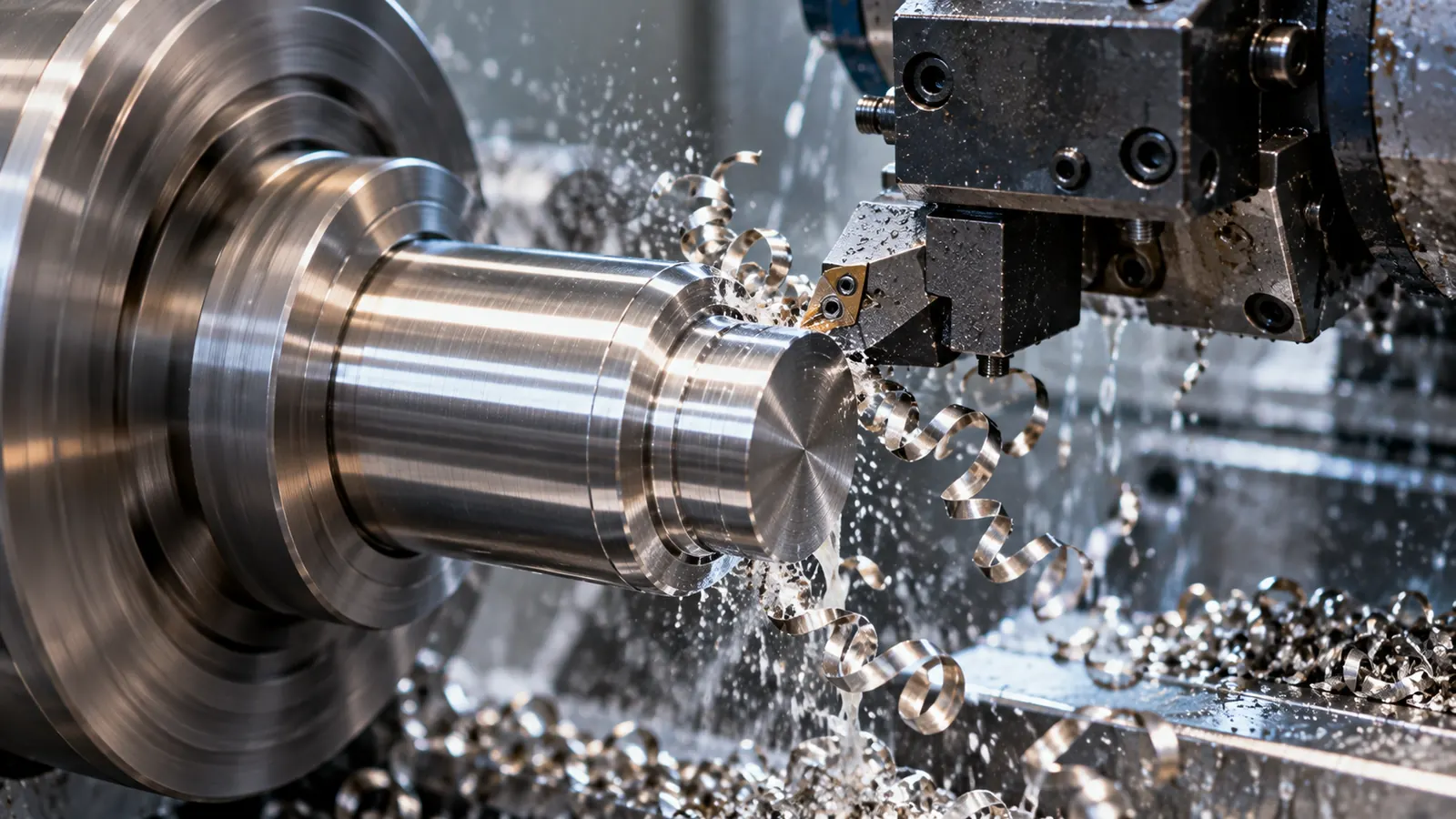
303 machines better because its sulfide inclusions act as built-in chip breakers and lubricate the cutting edge. Chips snap into short pieces instead of forming long, tough strings that wrap the tool and the part.
304 is notorious in the shop for three things: stringy chips, a built-up edge on the tool, and work hardening. Work hardening means the surface layer the tool just passed over becomes harder, so a tool that rubs instead of cutting makes the next pass harder still. 303 still work-hardens, but its chip control lets the tool keep cutting cleanly, so it runs at higher speeds, holds finish better and wears tools more slowly.
This is why 303 dominates screw-machine and CNC lathe work: fittings, shafts, bushings, valve parts, spacers, nuts and machined fasteners. For parts that are mostly machined from bar and then used in mild service, 303 is often the cheapest finished part even if the bar costs about the same.
303 corrosion resistance and welding
303 has lower corrosion resistance than 304 and should not be welded. The same sulfide inclusions that help machining are starting points for pitting, and the sulfur causes hot cracking in welds.
Corrosion
On paper, 303 has nearly the chromium of 304 and a similar PREN. In practice it pits more readily, especially in chlorides, because each sulfide inclusion exposed at the surface is a weak spot in the passive film. Avoid 303 for marine hardware, wetted parts in salt or chloride service, and surfaces that will be in long contact with moisture. Passivating 303 needs a treatment chosen for free-machining grades under ASTM A967 or A380; an aggressive acid can attack the inclusions and leave a frosted surface. More on this in does stainless steel rust.
Welding
Sulfur forms low-melting films at grain boundaries, so 303 welds are prone to solidification cracking. 303 is generally regarded as not weldable for structural or pressure-tight joints. If a machined part must be welded, make it from 304 or 304L, and accept the harder machining.
Forming
The inclusions also reduce ductility across the bar, so 303 is a poor choice for cold heading, crimping, flaring, swaging or tight bends. Cold-headed stainless screws are normally 304-type grades, not 303.
303 and 304 equivalents: EN, JIS and GB
303 is nearest to EN 1.4305 (X8CrNiS18-9), JIS SUS303 and China GB Y12Cr18Ni9; 304 is nearest to EN 1.4301 (X5CrNi18-10) and JIS SUS304. The "S" in the EN name and the "Y" prefix in the GB name both mark the free-machining sulfur addition.
| AISI / ASTM | UNS | EN number | EN name | JIS | China GB |
|---|---|---|---|---|---|
| 303 | S30300 | 1.4305 | X8CrNiS18-9 | SUS303 | Y12Cr18Ni9 |
| 304 | S30400 | 1.4301 | X5CrNi18-10 | SUS304 | 06Cr19Ni10 |
| 304L | S30403 | 1.4307 | X2CrNi18-9 | SUS304L | 022Cr19Ni10 |
| 316 | S31600 | 1.4401 | X5CrNiMo17-12-2 | SUS316 | 06Cr17Ni12Mo2 |
These come from the site's steel equivalents chart. They are nearest equivalents, not identical grades: limits for sulfur, carbon and nickel differ in detail. Each grade page, such as 303 stainless steel, lists the full designation set.
Machining 303 vs 304 vs 316 stainless steel
For machining, the order from easiest to hardest is 303, then 304, then 316. All three run at lower cutting speeds than carbon steel and need sharp tools, a steady feed and enough depth of cut to stay under the work-hardened layer.
| Machining factor | 303 | 304 | 316 |
|---|---|---|---|
| Ease of machining | Easiest | Harder | Hardest of the three |
| Chip form | Short, broken chips | Long, stringy chips | Long, stringy, gummy chips |
| Work hardening | Yes, less troublesome | Fast | Fast |
| Surface speed | Highest of the three | Lower than 303 | Slightly lower than 304 |
| Chip breaker needed | Helpful | Yes | Yes |
| Best for | High-volume lathe parts | Machined parts that are welded or need corrosion resistance | Machined parts for chloride service |
The rankings are qualitative; actual speeds and feeds depend on the tool maker's data for the insert grade, the machine and the setup. Practical rules for all three grades:
- Use sharp, positive-rake tools. A honed but sharp edge cuts; a worn edge rubs and work-hardens the surface. Change inserts before they dull, not after.
- Never dwell. Keep the feed going. Stopping a drill or tool in the cut work-hardens the bottom of the hole or the face.
- Take a real depth of cut. Light skimming passes run in the hardened skin left by the previous pass. Cut below it.
- Run slower than for carbon steel. Austenitic stainless conducts heat poorly, so heat stays at the cutting edge. Start from the tool maker's stainless recommendations and adjust for chip color and tool wear.
- Keep the setup rigid. Chatter work-hardens the surface and chips edges. Minimize stick-out.
- Use plenty of coolant. Flood coolant or a good cutting oil controls heat and built-up edge, especially on 304 and 316.
- Drill with cobalt or carbide. Split-point cobalt HSS or carbide drills with a steady, positive feed work best. See drill bits for metal and the drill size chart.
- Tap with less thread engagement. Stainless taps hard. A slightly larger tap drill that gives a lower percentage of thread reduces tap torque and breakage with little loss of strength. Check the result with the thread percentage calculator and the tap drill chart; see also types of taps.
Stainless fasteners also gall when tightened, which matters more than grade for assembly. Use anti-seize and the lubricated values in the bolt torque chart, and follow the fastener maker's torque where one is given.
When to use 303 or 304
Use 303 for machined parts in mild, dry or indoor service that will not be welded or cold formed. Use 304 for welded, formed or wetted parts, and 316 where chlorides are present.
- 303: fittings, shafts, bushings, spacers, valve stems and bodies for mild service, nuts and machined bolts, instrument and fixture parts.
- 304: anything welded, food and process equipment, tanks, sheet-metal parts, tube and pipe, cold-headed fasteners, and machined parts that need better corrosion resistance.
- 316: machined parts for marine, coastal, pool or chloride chemical service. See 304 vs 316 stainless steel.
Sources and standards
- ASTM A582
- ASTM A276
- ASTM A967
- EN 10088-3
- ISO 3506-1
General reference information. When a manufacturer, drawing or governing standard gives a value, that value takes precedence.
Related charts and guides
Common questions
What is the difference between 303 and 304 stainless steel?
303 is a free-machining version of 304 with at least 0.15 % sulfur, against a 0.030 % maximum in 304. The sulfur forms inclusions that break chips, so 303 machines much more easily. The trade-off is lower corrosion resistance, poor weldability and poor cold formability. Both are about 18 % chromium and 8–10 % nickel and non-magnetic when annealed.
Can 303 stainless steel be welded?
303 is generally not recommended for welding. Its 0.15 % minimum sulfur forms low-melting films at grain boundaries, so welds are prone to hot cracking, and the weld area loses corrosion resistance. If a machined part must be welded, make it from 304 or 304L instead and accept the harder machining.
Is 303 stainless steel as corrosion resistant as 304?
No. 303 has nearly the same chromium and nickel as 304, but its sulfide inclusions are weak points in the passive film where pitting starts, especially in chlorides. 303 is fine for indoor and mild service. For wet, salty or chemical service, use 304, or 316 where chlorides are present.
Is 303 stainless steel magnetic?
Annealed 303 stainless steel is non-magnetic, like 304, because both are austenitic grades. Cold-drawn bar and heavily machined or cold-worked areas can show slight magnetism. A magnet cannot be used to tell 303 from 304 or 316; use the mill certificate or a chemical analysis.
Which is easier to machine, 303, 304 or 316?
303 is the easiest, then 304, then 316. 303's sulfur breaks chips and allows higher cutting speeds. 304 and 316 form long, stringy chips and work-harden quickly, with 316 slightly gummier. All three need sharp positive-rake tools, steady feed, enough depth of cut and good coolant, at lower speeds than carbon steel.
What is the equivalent of 303 stainless steel?
The nearest equivalents of AISI 303 are EN 1.4305 (X8CrNiS18-9), JIS SUS303 and China GB Y12Cr18Ni9, with UNS number S30300. These are nearest equivalents, not identical grades, because sulfur, carbon and nickel limits differ in detail. The governing standard and the mill certificate decide.