Drill bits for metal: types, sizes and speeds
For most metal, use a high-speed steel (HSS) twist drill with a 135 degree split point; use cobalt (M35 or M42) for stainless and hard steel, and carbide only in rigid machines. Set speed with RPM = SFM × 3.82 / D: a 1/4 in HSS drill runs about 1,380 RPM in mild steel and 610 RPM in stainless.
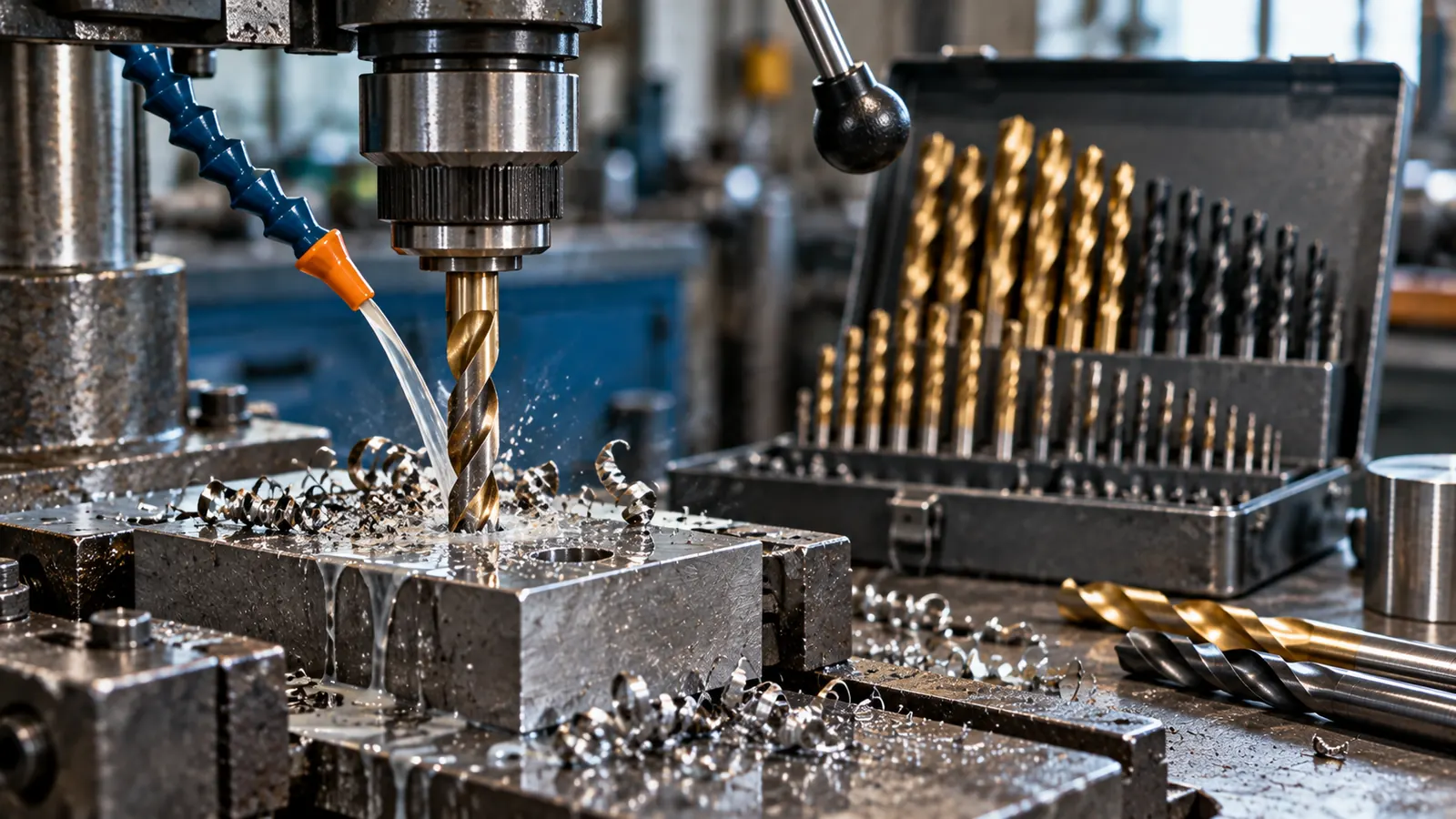
Key takeaways
- HSS twist drills suit mild steel, aluminum and brass; cobalt M35 or M42 drills suit stainless and hard steel.
- A titanium drill bit is HSS with a TiN coating; the coating adds wear life but not toughness.
- 118 degree points are general purpose; 135 degree split points self-center and cut harder metals better.
- Drill RPM = SFM × 3.82 / D (in), or Vc × 1000 / (π × D) with D in mm.
- Peck drill holes deeper than about 3 times the drill diameter.
What is the best drill bit for metal?
For most metal drilling, a high-speed steel (HSS) twist drill with a 135° split point is the right drill bit for metal. For stainless steel and hard alloys, use cobalt HSS (M35 or M42). Solid carbide drills are fastest but need a rigid machine; in a hand drill they chip and break.
| Drill material | What it is | Use it for |
|---|---|---|
| HSS (high-speed steel) | M2 or M7 tool steel, hardened | Mild steel, aluminum, brass, cast iron, wood and plastics; the general-purpose metal drill bit |
| Cobalt HSS (M35, M42) | HSS with about 5 % (M35) or 8 % (M42) cobalt, through the whole drill | Stainless steel, alloy and tool steels, tough or work-hardening metals |
| Solid carbide | Tungsten carbide in a cobalt binder | CNC machines with rigid setups; cast iron, hardened steel, high production |
| Carbide-tipped (masonry) | A carbide insert brazed to a steel body, blunt wedge point | Concrete and brick only; not for metal |
A drill bit for metal is a twist drill: a round shank, two helical flutes and a conical point with two straight cutting lips. A metal drill bit looks different from a wood brad point bit, which has a sharp center spur and two outer spurs, and from a masonry bit, which has a flat carbide tip. Most metal bits are marked HSS, HSS-Co or with a cobalt grade on the shank.
Cobalt drills are not coated with cobalt; the cobalt is alloyed through the steel, so the drill keeps its heat resistance after resharpening. Cobalt grades are a little more brittle than plain HSS, so they suit a drill press better than side-loaded hand drilling. The base material is described on the M2 high-speed steel page.
Drill bit coatings: black oxide, TiN and TiAlN
A coating adds wear resistance or reduces friction, but it does not change the drill's base material. A so-called titanium drill bit is an HSS drill with a titanium nitride (TiN) coating, not a drill made of titanium.
- Black oxide: a thin oxide finish on HSS that resists rust and holds cutting oil. Low cost, good for general steel drilling.
- Bright (uncoated): preferred for aluminum and other soft, sticky metals, where a polished flute reduces built-up edge.
- TiN (titanium nitride), gold: a hard ceramic coating that adds wear life in steel and cast iron. The point loses its coating when resharpened; the flutes and margins keep theirs.
- TiAlN or AlTiN (titanium aluminum nitride), dark gray to violet: keeps its hardness at higher temperatures, so it suits high-speed drilling of steel, stainless and cast iron, often on carbide drills.
A coated cheap drill is still a cheap drill. Geometry, grinding accuracy and the base steel matter more than the color of the coating.
118° vs 135° drill point angle
A 118° point is the general-purpose angle for mild steel, aluminum and soft metals. A 135° point is flatter, cuts harder materials such as stainless and alloy steel better, and is usually ground with a split point so it starts without walking.
- 118° conventional point: the long-standing standard. Its chisel edge does not cut; it pushes. Start it with a center punch or a spot drill.
- 135° split point: the split extends the cutting lips to the center, so the drill is self-centering and needs less thrust. A good choice for hand drills and for thin or hard material.
- Carbide drills: commonly 140° with special point geometry, made for machine use.
Spot drills for starting holes come in 90°, 118° and 120° and other angles. Choose a spot angle equal to or larger than the drill's point angle, so the drill's corners do not hit the edge of the spot first. A drill point gauge checks that the two lips are at the same angle and the same length. If one lip is longer, the drill cuts on that lip only and the hole comes out oversize.
Drill bit lengths: jobber, stubby and long drill bits
The standard length for twist drills is jobber length. Shorter stub (screw machine) drills are more rigid and more accurate; longer taper length and extra long drill bits reach deeper but flex and wander more. Lengths for each type are set in ASME B94.11M.
- Screw machine length (stub, stubby drill bits): the shortest standard length. Use it for accurate holes, hard materials and in tight spaces. A stubby drill wanders least.
- Jobber length: the everyday length found in most drill sets. A jobber length drill bit is the default unless a drawing or job says otherwise.
- Taper length: longer than jobber, for deeper holes in a drill press or lathe.
- Extra long and aircraft extension drills: long drill bits for metal commonly sold in 6, 12, 18 and 24 in overall lengths. Start the hole with a jobber drill first, then follow with the long drill at reduced speed.
- Reduced shank (Silver and Deming) drills: drills larger than 1/2 in with the shank turned down to 1/2 in to fit a 1/2 in drill chuck.
Rule of thumb: use the shortest drill that reaches the depth. A long drill bit in a hand drill bends easily; keep the drill straight and the feed light.
Drill size systems: number, letter, fractional and metric
Metal drills come in four size series. Number drills run from #80 (0.0135 in) to #1 (0.2280 in), letter drills from A (0.2340 in) to Z (0.4130 in), fractional drills in 1/64 in steps, and metric drills commonly in 0.1 mm steps.
- Drill size chart with every size and its decimal and mm equivalent.
- Number drills such as #7, the 1/4-20 tap drill, and #29, the 8-32 tap drill.
- Letter drills such as F, the 5/16-18 tap drill.
- Fractional drills such as 1/4 in, 3/8 in and 1/2 in.
- Inch to mm converter for finding the nearest metric drill.
The size to use depends on the job: a tap drill for threading, a clearance hole for a bolt to pass through, or a pilot hole for screws and rivets.
Drilling speed: how to calculate drill RPM
Drill RPM comes from the material's surface speed and the drill diameter: RPM = (SFM × 3.82) / D for D in inches, or RPM = (Vc × 1000) / (π × D) for Vc in m/min and D in mm. The 3.82 is 12 / π rounded. Smaller drills run faster; harder materials run slower.
Example: a 1/4 in HSS drill in mild steel at 90 SFM runs at 90 × 3.82 / 0.25 ≈ 1,380 RPM. The same drill in 304 stainless at 40 SFM runs at about 610 RPM. A 10 mm drill in mild steel at 27 m/min runs at 27 × 1000 / (π × 10) ≈ 860 RPM.
Surface speeds for HSS drills by material
These are typical starting ranges for HSS twist drills with coolant. Cobalt drills run in the same range or slightly above, and last longer at it; solid carbide typically runs about two to three times faster in a rigid machine. Start at the low end and go up if the drill cuts cleanly.
| Material | Surface speed, SFM (typical) | Surface speed, m/min (typical) |
|---|---|---|
| Aluminum alloys | 200 to 300 | 61 to 91 |
| Brass, free-cutting | 150 to 300 | 46 to 91 |
| Gray cast iron | 70 to 100 | 21 to 30 |
| Mild (low-carbon) steel, e.g. 1018, A36 | 80 to 100 | 24 to 30 |
| Alloy steel, annealed, e.g. 4140 | 50 to 70 | 15 to 21 |
| Austenitic stainless, e.g. 304, 316 | 30 to 50 | 9 to 15 |
Drill RPM chart for steel, stainless and aluminum
Calculated from RPM = 12 × SFM / (π × D) at the middle of each range and rounded to the nearest 10 RPM. Pick the nearest speed the drill press offers, rounding down.
| Drill | Inch | Mild steel, 90 SFM | Stainless, 40 SFM | Aluminum, 250 SFM |
|---|---|---|---|---|
| 1/8" | 0.1250 | 2,750 | 1,220 | 7,640 |
| 3/16" | 0.1875 | 1,830 | 810 | 5,090 |
| 1/4" | 0.2500 | 1,380 | 610 | 3,820 |
| 5/16" | 0.3125 | 1,100 | 490 | 3,060 |
| 3/8" | 0.3750 | 920 | 410 | 2,550 |
| 7/16" | 0.4375 | 790 | 350 | 2,180 |
| 1/2" | 0.5000 | 690 | 310 | 1,910 |
| 5/8" | 0.6250 | 550 | 240 | 1,530 |
| 3/4" | 0.7500 | 460 | 200 | 1,270 |
| 1" | 1.0000 | 340 | 150 | 950 |
| Drill | Mild steel, 27 m/min | Stainless, 12 m/min | Aluminum, 76 m/min |
|---|---|---|---|
| 3 mm | 2,860 | 1,270 | 8,060 |
| 4 mm | 2,150 | 950 | 6,050 |
| 5 mm | 1,720 | 760 | 4,840 |
| 6 mm | 1,430 | 640 | 4,030 |
| 8 mm | 1,070 | 480 | 3,020 |
| 10 mm | 860 | 380 | 2,420 |
| 12 mm | 720 | 320 | 2,020 |
| 14 mm | 610 | 270 | 1,730 |
| 16 mm | 540 | 240 | 1,510 |
| 20 mm | 430 | 190 | 1,210 |
Hand drills rarely reach the high speeds for small drills, and that is fine: run small drills as fast as the drill allows with a steady feed. Large drills in steel are the opposite: most cordless drills run a 1/2 in drill too fast in steel unless set to low gear.
Feeds, coolant and peck drilling
Feed the drill hard enough to make a continuous chip: rubbing at too light a feed dulls the drill and work-hardens stainless steel. Typical HSS feeds rise with diameter, from about 0.001 in/rev on drills under 1/8 in to 0.015 in/rev on 1 in drills.
| Drill diameter | Feed, in/rev (typical) | Feed, mm/rev (typical) |
|---|---|---|
| Under 1/8 in (3 mm) | 0.001 to 0.002 | 0.03 to 0.05 |
| 1/8 to 1/4 in (3 to 6 mm) | 0.002 to 0.004 | 0.05 to 0.10 |
| 1/4 to 1/2 in (6 to 13 mm) | 0.004 to 0.007 | 0.10 to 0.18 |
| 1/2 to 1 in (13 to 25 mm) | 0.007 to 0.015 | 0.18 to 0.38 |
Use the lower half of each range for stainless, tool steel and long drills, and the upper half for aluminum, brass and cast iron. In a hand drill, the chip is the guide: steel should come off as two even curls, and blue chips from HSS mean the speed is too high.
Coolant and cutting fluid
- Steel and stainless: cutting oil or soluble-oil coolant. In stainless steel, keep the drill cutting and well lubricated so it never dwells.
- Aluminum: a light cutting fluid or coolant stops chips welding to the flutes.
- Cast iron and brass: usually drilled dry; cast iron makes powdery chips.
Peck drilling
Peck drilling means retracting the drill at intervals to clear chips. Start pecking when the hole is deeper than about 3 times the drill diameter. A common starting peck is about one drill diameter, made shorter as the hole gets deeper. On CNC machines, G83 is the full-retract peck cycle and G73 the chip-breaking cycle.
For large holes, drill a pilot slightly larger than the big drill's chisel edge first, which cuts thrust force. In thin sheet, a step drill or hole saw makes rounder holes than a large twist drill. After drilling, deburr both sides. To thread the hole, see types of taps and the thread percentage calculator.
Sources and standards
- ASME B94.11M, Twist drills (number, letter, fractional and metric sizes)
- Machinery's Handbook (typical speeds and feeds)
General reference information. When a manufacturer, drawing or governing standard gives a value, that value takes precedence.
Related charts and guides
Common questions
What is the best drill bit for steel?
For mild steel, a high-speed steel (HSS) twist drill with a 135 degree split point works well. For stainless steel, tool steel and other hard or work-hardening steels, use cobalt HSS (M35 with about 5 percent cobalt or M42 with about 8 percent) at low speed with cutting oil. Solid carbide is best only in rigid CNC machines.
What do drill bits for metal look like?
A metal drill bit is a twist drill: a round shank, two spiral flutes and a cone-shaped point with two straight cutting lips, usually 118 or 135 degrees. It has no center spur like a wood brad point bit and no flat carbide tip like a masonry bit. The shank is often marked HSS or HSS-Co.
What is a jobber length drill bit?
Jobber length is the standard twist drill length in ASME B94.11M and the length in most drill sets. It is longer than a stub (screw machine) drill and shorter than taper length and extra long drills. Use a jobber drill unless the hole needs extra reach or extra rigidity.
Is a 118 or 135 degree drill bit better?
A 118 degree point is better for soft metals such as aluminum and mild steel. A 135 degree point, usually split, is better for stainless and hard steel and starts without walking, so it needs no center punch. For general use in a hand drill, a 135 degree split point is the easier choice.
What RPM should I drill steel at?
Use RPM = SFM × 3.82 / D. HSS drills in mild steel run at a typical 80 to 100 SFM, so a 1/4 in drill runs about 1,380 RPM and a 1/2 in drill about 690 RPM at 90 SFM. Stainless steel needs about 30 to 50 SFM, so roughly half those speeds.
How can you tell a metal drill bit from a wood bit?
A metal drill bit has a plain conical point with two cutting lips, usually ground at 118 or 135 degrees, and is often marked HSS. A wood brad point bit has a sharp center spur and outer spurs; a spade bit is flat. Masonry bits have a wide carbide tip and are not for metal.
What are the types of drill bits for metal?
The main drill bits for metal are twist drills in HSS, cobalt or carbide; step drills for sheet metal; hole saws and annular cutters for large holes; and spot or center drills for starting holes. Twist drills come in stub, jobber, taper and extra long lengths.