Pilot hole size chart for screws, lag bolts and rivets
A pilot hole should match the screw's root diameter: slightly smaller in softwood, equal in hardwood. For a #8 wood screw drill 7/64 in in hardwood or 3/32 in in softwood. For a 3/8 in lag screw drill 7/32 in in softwood or 9/32 in in oak. A 1/8 in pop rivet needs a #30 drill.
Key takeaways
- A pilot hole is about the root diameter of the screw thread, smaller in softwood than in hardwood.
- Typical #8 wood screw pilot: 7/64 in in hardwood, 3/32 in in softwood, with an 11/64 in shank hole.
- Per the NDS, a lag screw lead hole is 40 to 85 percent of the shank diameter, depending on wood density.
- Blind rivets: 1/8 in uses a #30 drill, 5/32 in a #20 drill and 3/16 in a #11 drill.
- Pilot holes are not tap drills; machine threads in metal need a tap drill and a tap.
What is a pilot hole and how big should it be?
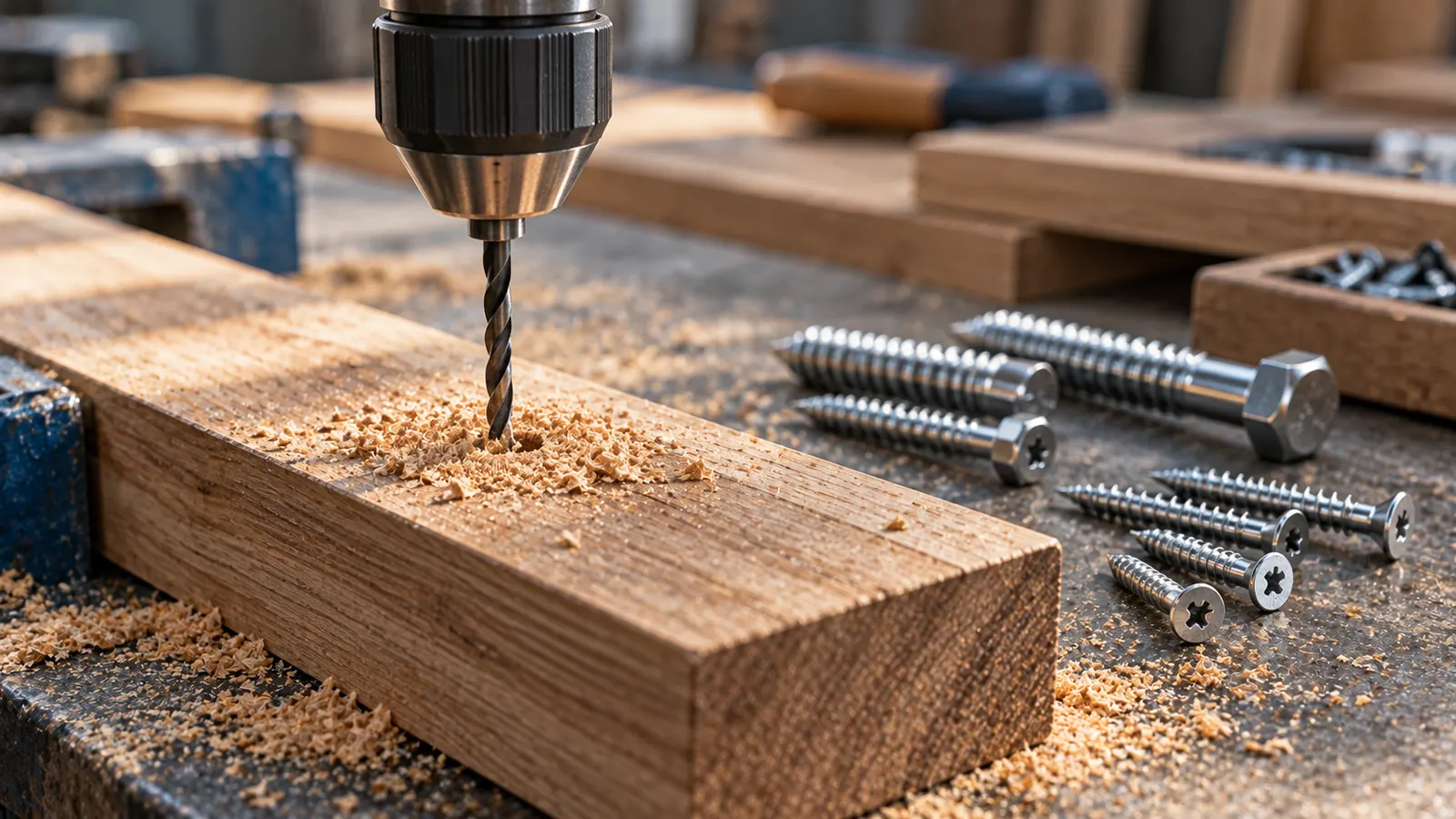
A pilot hole is a small hole drilled before driving a screw, so the screw cuts or presses its thread into the wood without splitting it or snapping. As a rule, a pilot hole is about the size of the screw's root (minor) diameter: slightly smaller in softwood, equal to it in hardwood.
This pilot hole size chart covers the four common cases: wood screws, lag screws (lag bolts), sheet metal and self-tapping screws, and blind rivets. Drill bit sizes are given as standard fractional, number and letter drills from ASME B94.11M; every size links to its drill size page with the metric equivalent.
Three holes are involved in a screwed wood joint:
- Pilot hole in the part the thread grips, sized to the root diameter.
- Shank (clearance) hole in the part being clamped, sized to the screw's major diameter so the screw pulls the two parts together. This is the wood version of a clearance hole.
- Countersink or counterbore for the head, so a flat head screw sits flush.
A pilot hole that is too small splits the wood, strips the screw head or snaps the screw. One that is too large leaves too little wood in the thread and the screw pulls out. When in doubt, drill a test hole in scrap of the same wood.
Pilot hole size chart for wood screws
For a #8 wood screw, drill a 7/64 in pilot hole in hardwood or 3/32 in in softwood. For a #10 wood screw, drill 1/8 in in hardwood or 7/64 in in softwood. The chart lists typical values widely used in woodworking for screw gauges #4 to #14.
Wood screw gauge numbers follow the same diameter formula as machine screws: D = 0.060 + 0.013 × N inches, so a #8 screw is 0.164 in. That formula gives the wood screw diameter chart in the second column.
| Wood screw | Major dia. in | Pilot, hardwood | Pilot, softwood | Shank clearance hole |
|---|---|---|---|---|
| #4 | 0.112 (2.84 mm) | 5/64" (0.0781) | 1/16" (0.0625) | 7/64" (0.1094) |
| #6 | 0.138 (3.51 mm) | 3/32" (0.0938) | 5/64" (0.0781) | 9/64" (0.1406) |
| #8 | 0.164 (4.17 mm) | 7/64" (0.1094) | 3/32" (0.0938) | 11/64" (0.1719) |
| #10 | 0.190 (4.83 mm) | 1/8" (0.1250) | 7/64" (0.1094) | 3/16" (0.1875) |
| #12 | 0.216 (5.49 mm) | 9/64" (0.1406) | 1/8" (0.1250) | 7/32" (0.2188) |
| #14 | 0.242 (6.15 mm) | 5/32" (0.1562) | 9/64" (0.1406) | 1/4" (0.2500) |
The pilot sizes are typical, not a standard. Makers of modern coarse-thread construction and cabinet screws often give their own values, and the right size shifts with the wood's density, moisture and grain direction. Screws into end grain hold poorly; use a pilot at the softwood size or smaller and a longer screw.
Hardwood vs softwood pilot holes
Softwood pilot holes are one 1/64 in step smaller than hardwood ones. Softwood fibers compress around the thread and grip it, so a small hole is enough. Hardwood fibers do not compress, so a small hole splits the board or overloads the screw. Brass screws are weak in torsion; use the hardwood size, or drive a steel screw of the same size first to cut the thread, then replace it.
How deep should a pilot hole be?
Drill the pilot as deep as the threaded length of the screw goes into the lower part. Drill the full depth in hardwood, where a screw bottoming in an undrilled section can split the board or snap. The shank hole goes only through the top board.
Lag screw pilot hole size chart
For a 3/8 in lag screw, drill a 7/32 in pilot in softwood or a 9/32 in pilot in oak, and a 3/8 in shank hole as deep as the unthreaded shank. Lag screws and lag bolts are the same fastener: a hex-head wood screw with a coarse thread.
The ranges follow the lead-hole rule in the National Design Specification (NDS) for wood construction. The clearance hole for the shank has the same diameter as the shank and the same depth as the unthreaded part of the shank. The lead hole for the threaded part is a fraction of the shank diameter that depends on the wood's specific gravity G:
- G ≤ 0.5 (softwoods such as spruce-pine-fir, hem-fir, Douglas fir-larch): 40 % to 70 % of the shank diameter.
- 0.5 < G ≤ 0.6 (for example southern pine): 60 % to 75 % of the shank diameter.
- G > 0.6 (dense hardwoods such as red and white oak): 65 % to 85 % of the shank diameter.
The table applies that rule. The suggested bit is the 1/32 in size nearest to 60 %, 70 % and 75 % of the shank diameter for the three density classes, kept inside the allowed range.
| Lag screw | Shank hole | Thread pilot, G ≤ 0.5 (in; bit) | Thread pilot, G 0.5 to 0.6 (in; bit) | Thread pilot, G > 0.6 (in; bit) |
|---|---|---|---|---|
| 1/4" | 1/4" | 0.100 to 0.175; 5/32" | 0.150 to 0.188; 3/16" | 0.163 to 0.212; 3/16" |
| 5/16" | 5/16" | 0.125 to 0.219; 3/16" | 0.188 to 0.234; 7/32" | 0.203 to 0.266; 1/4" |
| 3/8" | 3/8" | 0.150 to 0.262; 7/32" | 0.225 to 0.281; 1/4" | 0.244 to 0.319; 9/32" |
| 1/2" | 1/2" | 0.200 to 0.350; 5/16" | 0.300 to 0.375; 11/32" | 0.325 to 0.425; 3/8" |
Pilot hole for a 1/4 in lag screw
A 1/4 in lag screw takes a 5/32 in pilot in softwood such as spruce, pine or fir, and a 3/16 in pilot in oak. Drill a 1/4 in shank hole through the part being fastened.
Pilot hole for a 5/16 in lag bolt
A 5/16 in lag bolt takes a 3/16 in pilot in softwood, 7/32 in in southern pine and 1/4 in in oak, with a 5/16 in shank hole.
Pilot hole for a 1/2 in lag screw
A 1/2 in lag screw takes a 5/16 in pilot in softwood and a 3/8 in pilot in oak, with a 1/2 in shank hole.
Soap or wax on the thread makes large lag screws much easier to drive. A lag screw that stalls before seating is a sign the pilot is too small for that wood.
Pilot holes for sheet metal and self-tapping screws
A thread-forming sheet metal screw (Type A or AB) needs a pilot hole close to its root diameter. A self-drilling screw, with a drill-shaped point, needs no pilot hole at all in the sheet thickness it is made for.
- Measure the screw: read the root diameter with calipers between the threads, then pick the nearest drill from the drill size chart. Number drills give fine steps below 1/4 in.
- Thin sheet: in thin steel the pilot can be at or slightly above the root diameter, because only one or two threads engage.
- Thicker or harder material: go one drill size larger to keep driving torque down, especially in stainless steel.
- Aluminum and plastics: go slightly smaller than for steel, since soft material strips easily.
Pilot sizes for tapping screws depend on the screw type and sheet gauge, so the screw maker's chart wins. For a true machine thread in metal, tap the hole instead: a 1/4-20 thread needs a #7 tap drill and a tap, not a sheet metal screw.
What size drill bit for a pop rivet?
For a 1/8 in pop rivet, use a #30 drill (0.1285 in). For a 3/16 in rivet, use a #11 drill (0.1910 in), and for a 5/32 in rivet, a #20 drill (0.1610 in). These are the standard drill sizes for blind rivets; the hole is a few thousandths over the rivet body so it slips in without play.
| Rivet diameter in | Drill | Drill in | Drill mm | Hole over rivet in |
|---|---|---|---|---|
| 3/32" (0.0938) | #41 | 0.0960 | 2.44 | 0.0023 |
| 1/8" (0.1250) | #30 | 0.1285 | 3.26 | 0.0035 |
| 5/32" (0.1562) | #20 | 0.1610 | 4.09 | 0.0048 |
| 3/16" (0.1875) | #11 | 0.1910 | 4.85 | 0.0035 |
| 1/4" (0.2500) | F | 0.2570 | 6.53 | 0.0070 |
A hole much larger than this lets the rivet tilt and swell unevenly, which weakens the joint. Drill both sheets together, clamped, and deburr before setting. Grip range, the total thickness the rivet can join, is marked on the rivet box and matters as much as the diameter.
Pilot hole vs tap drill: what is the difference?
A pilot hole is for a screw that makes its own thread in wood, plastic or sheet. A tap drill is for a hole that a tap threads to a standard machine thread, such as 1/4-20 or M6. Tap drill sizes are set by the thread geometry; pilot holes are set by the material.
The same 1/4 in diameter shows how far apart the sizes are:
| Hole for a 1/4 in fastener | Drill | Inch | Why |
|---|---|---|---|
| Lag screw thread pilot, softwood | 5/32" | 0.1562 | Wood fibers compress around a coarse, deep thread |
| Lag screw thread pilot, oak | 3/16" | 0.1875 | Dense wood needs a larger lead hole to avoid splitting |
| 1/4-20 UNC tap drill | #7 | 0.2010 | About 75 % thread in metal |
| 1/4-28 UNF tap drill | #3 | 0.2130 | About 80 % thread in metal |
| Clearance hole, close fit | F | 0.2570 | Bolt passes through without threading |
Never use a wood pilot chart to tap metal. For machine threads use the tap drill chart, for example M6 (5 mm), 10-24 or 3/8-16. The thread percentage calculator shows how much thread a given drill leaves.
How to choose a pilot hole drill bit
Hold the drill bit in front of the screw: the bit should cover the solid core of the screw but leave the threads showing on both sides. That quick check matches the rule that a pilot equals the root diameter.
- Use a brad point or standard twist drill for wood pilot holes; a combination pilot bit with countersink drills the pilot, shank and countersink in one pass for a given screw gauge.
- Use a twist drill in HSS for sheet metal and rivet holes; see drill bits for metal for speeds.
- For wall anchors, use the drill size printed on the anchor package. The anchor must fit snugly, so do not substitute a size.
- Convert any fractional size to mm with the inch to mm chart when only metric bits are at hand.
Sources and standards
- ASME B94.11M, Twist drills (number, letter, fractional and metric sizes)
- ANSI/AWC NDS (lag screw lead holes)
- IFI blind rivet practice
General reference information. When a manufacturer, drawing or governing standard gives a value, that value takes precedence.
Related charts and guides
Common questions
What size pilot hole for a #8 wood screw?
For a #8 wood screw (0.164 in diameter), a typical pilot hole is 7/64 in in hardwood and 3/32 in in softwood. Drill an 11/64 in shank hole through the top board so the screw pulls the parts together. Test in scrap, since wood density varies.
What size pilot hole for a #10 screw?
For a #10 wood screw (0.190 in diameter), a typical pilot hole is 1/8 in in hardwood and 7/64 in in softwood, with a 3/16 in shank hole in the top board. In metal, a 10-24 thread needs a #25 tap drill instead of a pilot hole.
What size pilot hole for a 3/8 lag screw?
For a 3/8 in lag screw, drill a 7/32 in pilot for the threaded part in softwood, 1/4 in in southern pine or 9/32 in in oak, plus a 3/8 in hole as deep as the unthreaded shank. These follow the NDS rule of 40 to 85 percent of shank diameter by wood density.
What size pilot hole for a 5/16 lag bolt?
For a 5/16 in lag bolt, drill a 3/16 in pilot in softwood, 7/32 in in southern pine or 1/4 in in dense hardwood such as oak. Drill a 5/16 in shank hole through the part being fastened, as deep as the unthreaded shank.
What size pilot hole for a 1/4 lag screw?
For a 1/4 in lag screw, drill a 5/32 in pilot in softwood and a 3/16 in pilot in oak, with a 1/4 in shank hole. The NDS allows 40 to 70 percent of the shank diameter in softwood and 65 to 85 percent in wood with specific gravity over 0.6.
What size drill bit for a 1/8 pop rivet?
A 1/8 in pop rivet uses a #30 drill, which is 0.1285 in (3.26 mm). The hole is a few thousandths over the rivet so it slips in without play. A 5/32 in rivet uses a #20 drill and a 3/16 in rivet a #11 drill.
What size screw for a 3/32 pilot hole?
A 3/32 in pilot hole suits a #6 wood screw in hardwood or a #8 wood screw in softwood, using typical woodworking values. For a #6 screw in softwood, 5/64 in is the usual pilot. Always test in scrap of the same wood.
How do I know what size pilot hole to drill?
Hold the drill bit in front of the screw: it should hide the solid core but leave the threads visible on both sides. That matches the root diameter. Go slightly smaller in softwood and use the full root size in hardwood, then test in scrap.