Does stainless steel rust? Why it happens and how to stop it
Yes, stainless steel does rust under some conditions. Its minimum 10.5 % chromium forms a passive oxide film that normally stops rust, but chlorides, crevices, carbon steel contamination, weld heat tint and low-chromium grades can break it. Pitting resistance rises with PREN = %Cr + 3.3 × %Mo + 16 × %N: about 18–20 for 304, 24–26 for 316 and 34–36 for 2205.
Key takeaways
- Stainless steel can rust when chlorides, crevices, iron contamination or weld heat tint break its chromium-oxide film.
- PREN = %Cr + 3.3 × %Mo + 16 × %N; typical values are 304 ≈ 18–20, 316 ≈ 24–26, 2205 ≈ 34–36.
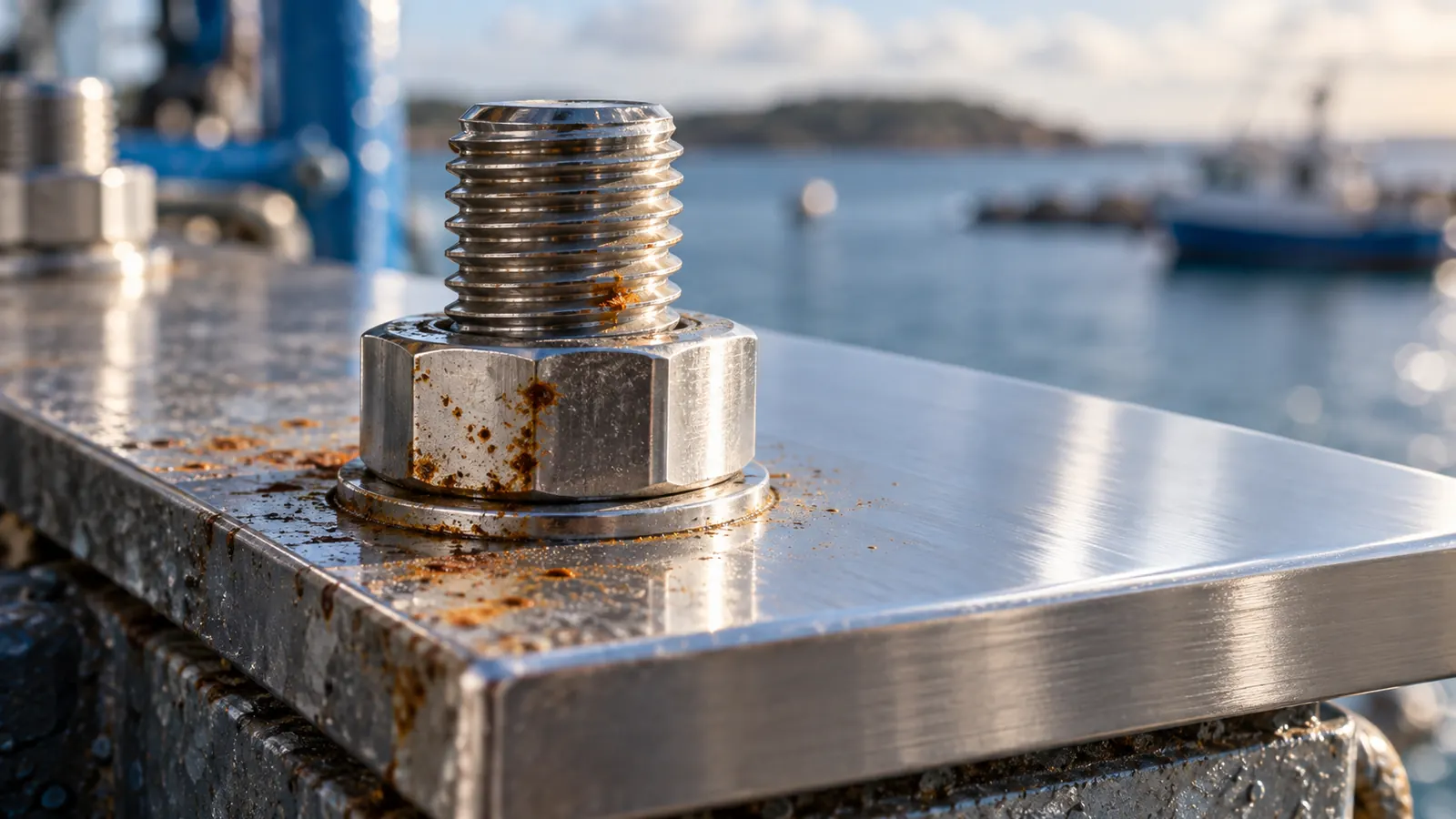
- Orange specks are often embedded carbon steel particles, not corrosion of the stainless itself.
- Passivation to ASTM A967 or A380 removes free iron; it does not remove heat tint or scale.
- 316 is the usual minimum for coastal use; immersion and warm seawater need duplex or higher alloys.
Does stainless steel rust?
Yes, stainless steel can rust. It resists rust because of a thin chromium-oxide film on its surface, but chlorides, crevices, iron contamination, weld heat tint and low-chromium grades can break that film and let the steel corrode.
Stainless steel is an iron alloy with at least 10.5 % chromium. The chromium reacts with oxygen to form a passive layer only a few nanometers thick. The layer is invisible, stable and self-healing: a scratch re-passivates in air or oxygen-bearing water. As long as the film holds, the steel underneath does not rust. When the environment attacks the film faster than it can repair itself, rust appears.
So the useful question is not whether stainless steel rusts, but which grade rusts in which environment. 304 stays bright for decades in a kitchen and can show rust spots within months on a seafront railing. 316 holds up in that railing but can still pit under a gasket in warm seawater. The family and grade are explained in stainless steel grades explained.
Why does stainless steel rust?
Stainless steel rusts when its passive film is damaged and cannot re-form. The usual causes are chloride salts, oxygen-starved crevices, embedded carbon steel particles, and surfaces damaged by welding or heat.
| Cause | Where it comes from | What it looks like |
|---|---|---|
| Chlorides (salt) | Seawater, coastal air, road salt, pool water, bleach, some cleaners | Pitting: small deep pits, often with a brown halo |
| Crevices | Under washers, gaskets, deposits, clamps and lap joints | Crevice corrosion: rust bleeding out of a joint |
| Iron contamination | Carbon steel grinding dust, steel wool, steel wire brushes, shared tools | Orange specks that wipe or scrub off |
| Tea staining | Coastal and polluted air on rough or unwashed surfaces | Even light-brown film, usually cosmetic |
| Welding heat tint | Straw to blue oxide next to welds, not removed | Rust along the weld line |
| Sensitization | Standard-carbon grades held at 425–815 °C (800–1500 °F), for example during welding | Intergranular attack next to welds |
| Low-chromium grade | 410 or 430 used outdoors or in wet service | General light rusting |
Chlorides and pitting
Chloride ions, from salt water, coastal spray, de-icing salt, swimming pools and bleach, are the main enemy of stainless steel. They break the passive film at weak points and start pits. A pit is acidic and oxygen-poor inside, so it keeps growing even when the surface around it stays bright. Higher temperature, higher chloride concentration and lower pH all make pitting more likely.
Crevice corrosion
A crevice is any tight gap where water can enter but oxygen cannot be refreshed: under a washer, a gasket, a clamp, a label or a pile of deposit. Without oxygen the film cannot repair itself, and chlorides concentrate. Crevice corrosion starts at lower temperatures than pitting on an open surface, so joint design matters as much as grade.
Iron contamination
Many "rusty stainless" complaints are not the stainless rusting at all. Particles of carbon steel from a grinder, a shared wire brush, steel wool, steel chips from a nearby lathe, or lifting chains embed in the surface and rust. The orange specks look alarming but lie on the surface. Keep stainless-only brushes, discs and files, and cover stainless stock when carbon steel is being ground nearby.
Tea staining
Tea staining is a light brown discoloration on stainless steel exposed to coastal or polluted air, especially on rough finishes and surfaces that rain does not wash. It is usually cosmetic, but it is the first sign that the grade or finish is marginal for the site. Smoother finishes, 316 in place of 304, and regular washing reduce it.
Welds and heat
Welding leaves heat tint, a colored oxide that has less chromium than the base metal and rusts first. Standard-carbon austenitic grades held between about 425 and 815 °C (800 and 1500 °F) can also form chromium carbides at grain boundaries, a condition called sensitization, which causes intergranular corrosion next to the weld. Low-carbon grades such as 304L and 316L and the titanium-stabilized 321 avoid this.
Chloride stress-corrosion cracking
Austenitic grades such as 304 and 316 can crack under tensile stress in warm chloride solutions, generally above about 60 °C (140 °F). This is a cracking failure, not surface rust, and it can happen with very little visible corrosion. Duplex grades such as 2205 resist it much better.
Corrosion resistance of stainless steel: PREN
The Pitting Resistance Equivalent Number (PREN) ranks how well a stainless grade resists pitting in chlorides. A higher PREN means better resistance. The common formula is PREN = %Cr + 3.3 × %Mo + 16 × %N.
Molybdenum counts 3.3 times as much as chromium, which is why 2–3 % molybdenum moves 316 well above 304. Nitrogen counts 16 times, which is why duplex grades add it. For a typical 316 heat with 17 % Cr, 2.1 % Mo and 0.05 % N, the result is 17 + 3.3 × 2.1 + 16 × 0.05 = 24.7.
| Grade (EN number) | Family | Typical PREN | Typical environment without rust |
|---|---|---|---|
| 410 (1.4006) | Martensitic stainless | ≈ 12–13 | Indoor, dry; rusts quickly outdoors unless coated |
| 430 (1.4016) | Ferritic stainless | ≈ 16–18 | Indoor, mild; light rust spots outdoors are common |
| 304 (1.4301) | Austenitic stainless | ≈ 18–20 | Indoor, fresh water, rural and urban air |
| 316 (1.4401) | Austenitic stainless with molybdenum | ≈ 24–26 | Coastal air, de-icing salt, pools, many chemicals |
| 2205 duplex (1.4462) | Duplex (austenitic-ferritic) stainless | ≈ 34–36 | Warm chlorides, seawater splash, offshore |
PREN values are typical, calculated from typical heat analyses; a heat at the bottom of its composition limits scores lower. Work out the PREN of a specific heat from the mill certificate. PREN is a ranking tool, not a guarantee: it ignores surface finish, crevices, temperature and inclusions. Free-machining 303 has a PREN close to 304 on paper but pits more readily, because its sulfide inclusions are starting points for pits.
Does 304 or 316 stainless steel rust?
Both can rust. 304 resists rust well indoors, in fresh water and in normal inland air, but pits and tea-stains in salt exposure. 316 resists chlorides better because of its 2–3 % molybdenum, but it can still pit or crevice-corrode in warm seawater and stagnant brine.
Does stainless steel rust in water? In clean fresh water and potable tap water, 304 and 316 normally do not rust; both are used for plumbing, tanks and brewing equipment. Risk rises with chloride content, temperature, stagnant water, deposits and crevices. In seawater, 304 is not suitable for immersion, and 316 is marginal in crevices and warm water. For a full side-by-side, see 304 vs 316 stainless steel.
Ferritic 430 and martensitic 410, 420 and 440C have less chromium or no molybdenum, and rust more easily than 304. Hardened martensitic parts such as knives and bearing races resist corrosion best when polished and kept dry.
How to prevent stainless steel from rusting
Prevent stainless steel rust by choosing a grade suited to the chloride level, avoiding crevices, keeping carbon steel contamination off the surface, cleaning welds properly, and washing exposed surfaces regularly.
- Match the grade to the environment. Use 304 indoors and inland, 316 within reach of salt or de-icing salt, and 2205 or a higher alloy for warm chlorides and immersion.
- Design out crevices. Use continuous welds instead of stitch welds, seal or avoid lap joints, let water drain, and keep deposits from collecting.
- Use stainless fasteners of the same grade or better. A 304 bolt in a 316 bracket corrodes first. ISO 3506 class A4 fasteners are the 316-type. Carbon steel or zinc-plated fasteners in stainless parts rust and stain the stainless.
- Keep tools separate. Use stainless-only wire brushes, flap discs and files. Never use carbon steel wool on stainless.
- Clean the welds. Remove heat tint and scale by pickling or careful mechanical cleaning, then passivate.
- Choose a smooth finish outdoors. Polished and electropolished surfaces hold less salt and stain less than coarse ground finishes.
- Wash exposed surfaces. Fresh-water washing of coastal and sheltered surfaces removes the salt that rain does not reach.
- Avoid chlorine cleaners. Bleach and hydrochloric-acid cleaners attack the passive film. Rinse any cleaner off completely.
How to remove rust from stainless steel
Remove light rust from stainless steel with a non-chloride, mildly acidic cleaner such as an oxalic-acid or phosphoric-acid stainless cleaner and a non-metallic pad, working along the grain, then rinse with clean water and dry.
- Surface specks from iron contamination: oxalic-acid cleaner or a commercial stainless cleaner, nylon or non-woven abrasive pad, rinse.
- Tea staining: stainless cleaner and washing; a smoother finish if it keeps coming back.
- Weld heat tint and scale: pickling paste or gel, or electrochemical weld cleaning, then rinse.
- Pitting: cleaning removes the stain, not the pit. Deep pits need the surface ground and refinished, or the part replaced in a better grade.
Do not use carbon steel wool, carbon steel wire brushes, or abrasives already used on carbon steel. They leave new iron in the surface and the rust returns.
Passivation of stainless steel
Passivation is a chemical treatment that removes free iron and other contamination from a stainless steel surface so the chromium-oxide film can form fully. It is usually done in nitric acid or citric acid solutions under ASTM A967 or ASTM A380.
ASTM A967 covers chemical passivation treatments for stainless steel parts, with nitric acid and citric acid methods and tests to verify the result. ASTM A380 is the broader practice for cleaning, descaling and passivating stainless parts, equipment and systems. Citric acid is less hazardous to handle; nitric acid treatments are long established and some include sodium dichromate for certain grades. The right method depends on the grade: free-machining 303 and the martensitic grades need treatments chosen for them, or they can etch.
Passivation is not pickling. It does not remove heat tint, mill scale or deep rust; those need pickling or mechanical removal first. Machined parts are commonly passivated after machining to remove iron picked up from tools. Machining practice for stainless is covered in 303 vs 304 stainless steel.
Which stainless steel for marine and coastal use?
316 or 316L is the usual minimum for marine and coastal use. For continuous seawater immersion, warm seawater or tight crevices, duplex 2205 or higher-alloyed grades are used because even 316 can pit there.
- Coastal air, away from direct spray: 304 can work with a smooth finish and washing; 316 is safer.
- Seafront, splash zone, boat deck hardware: 316 or 316L with a polished finish, A4 fasteners and no crevices.
- Immersion, warm seawater, offshore: 2205 duplex or higher-alloyed grades, chosen against the specific conditions.
- Avoid near salt water: 303, 410, 420, 430 and 201.
"Marine grade" is a trade name, not a standard. It usually means 316, sometimes 316L. The steel equivalents chart gives the EN and JIS names for these grades; the governing standard and mill certificate decide what was actually supplied.
Sources and standards
- EN 10088-1, Stainless steels, list of stainless steels
- ASTM A967
- ASTM A380
- ISO 3506-1
General reference information. When a manufacturer, drawing or governing standard gives a value, that value takes precedence.
Related charts and guides
Common questions
Can stainless steel rust?
Yes. Stainless steel resists rust because at least 10.5 % chromium forms a passive oxide film, but the film can break down. Chloride salts, crevices, carbon steel particles from tools, weld heat tint and low-chromium grades such as 410 and 430 are the usual causes. The right grade for the environment and clean fabrication prevent most rust.
Does 304 stainless steel rust?
304 stainless steel does not rust in normal indoor use, fresh water or inland air, but it can pit and tea-stain where salt is present, such as seafront railings, pool areas and roads treated with de-icing salt. Its typical PREN is about 18–20. For salt exposure, 316 with 2–3 % molybdenum is the usual upgrade.
Does 316 stainless steel rust?
316 stainless steel resists rust better than 304 because of its 2–3 % molybdenum, giving a typical PREN of about 24–26. It can still tea-stain in coastal air and pit or crevice-corrode in warm seawater, stagnant brine and tight joints. For seawater immersion and warm chlorides, duplex 2205 or higher alloys are used.
Does stainless steel rust in water?
In clean fresh water and tap water, 304 and 316 stainless steel normally do not rust. Risk rises with chloride content, temperature, stagnant water, deposits and crevices. 304 is not suitable for seawater immersion, and 316 is marginal there, especially in crevices; duplex 2205 or higher-alloyed grades are used for continuous seawater service.
Why is my stainless steel rusting?
The most common reasons are salt or chlorides on the surface, iron contamination from carbon steel tools, grinding dust or steel wool, crevices that trap water, uncleaned weld heat tint, or a lower grade such as 430 or 201 used outdoors. Specks that scrub off are usually contamination; pits that stay after cleaning are real corrosion.
How do you remove rust from stainless steel?
Use a non-chloride stainless cleaner, such as an oxalic-acid or phosphoric-acid product, with a nylon or non-woven pad, working along the grain. Rinse with clean water and dry. Never use carbon steel wool or brushes. Weld heat tint needs pickling paste or electrochemical cleaning, and passivation afterwards restores the protective film.
What is stainless steel passivation?
Passivation is a chemical treatment, usually in nitric or citric acid, that removes free iron and contamination from a stainless steel surface so the chromium-oxide film can form fully. ASTM A967 and ASTM A380 define the methods and tests. It does not remove heat tint, mill scale or deep rust; those need pickling or mechanical cleaning first.
Does stainless steel oxidize?
Yes. Stainless steel resists corrosion precisely because its chromium oxidizes, forming a passive chromium-oxide film only a few nanometers thick. This oxide protects the iron underneath. At high temperature it forms a thicker, colored oxide, such as weld heat tint, which is less protective and should be removed from parts in corrosive service.