Ball bearing materials: chrome steel, stainless and ceramic bearings
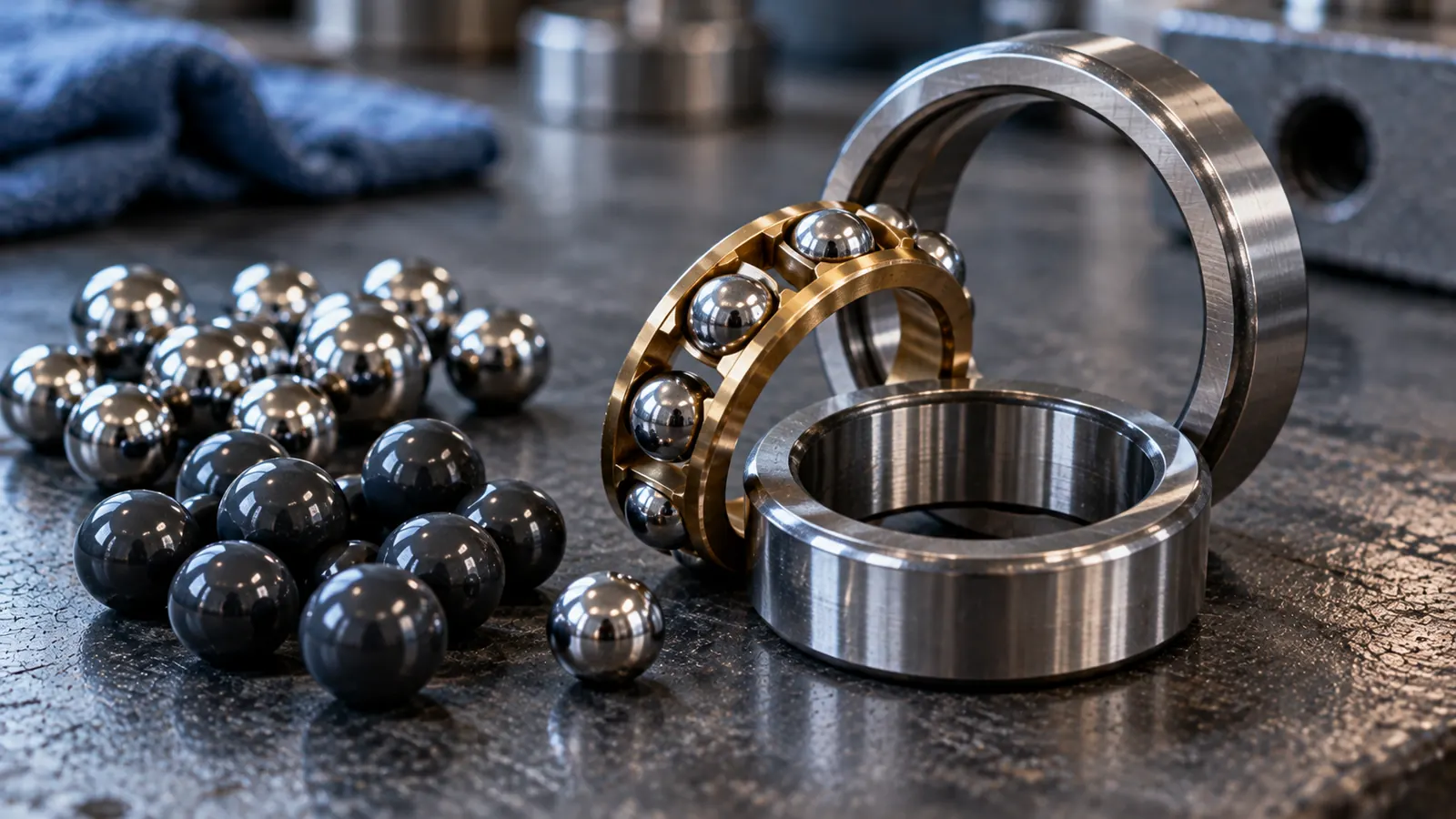
Most ball bearings use 52100 chrome steel (100Cr6, SUJ2, GCr15) hardened to about 58–65 HRC. Stainless steel bearings use 440C for corrosion resistance at somewhat lower load capacity. Ceramic bearings use silicon nitride balls, about 3.2 g/cm³ against 7.8 for steel: hybrid ceramic bearings have steel rings and ceramic balls; full ceramic bearings are ceramic throughout.
Key takeaways
- 52100 chrome steel is the standard bearing material; its equivalents are 100Cr6 (1.3505), SUJ2 and GCr15.
- Hardened bearing steel is typically 58 to 65 HRC.
- 440C stainless resists water and mild chemicals but carries less load than 52100 and is usually derated by makers.
- Silicon nitride balls are about 60 % lighter than steel balls (about 3.2 vs 7.8 g/cm³), stiffer and electrically insulating.
- Hybrid ceramic bearings (steel rings, Si3N4 balls) suit high speed and motors with stray electrical current.
Ceramic bearings, steel and stainless: the main bearing materials
Three materials cover almost every ball bearing: 52100 chrome steel for general use, 440C martensitic stainless steel for wet or mildly corrosive service, and silicon nitride ceramic for high speed, electrical insulation or extreme environments. The bearing material decides load capacity, corrosion resistance, speed and price.
| Material | Typical density, g/cm³ | Corrosion resistance | Relative load capacity | Magnetic | Main use |
|---|---|---|---|---|---|
| 52100 chrome steel | 7.8 | Low (rusts) | Reference | Yes | Almost all standard bearings |
| 440C stainless steel | 7.7 | Moderate | Lower than 52100 | Yes | Food, marine, wet and wash-down service |
| 316 stainless steel (unhardened) | 8.0 | High | Much lower | Weakly or not | Light-load corrosive service, plastic bearing balls |
| Silicon nitride (Si3N4) | 3.2 | Very high | Check maker's hybrid ratings | No | Hybrid and full ceramic bearings |
| Zirconia (ZrO2) | 6.0 | Very high | Lower than Si3N4 | No | Full ceramic bearings for chemicals |
| Glass (soda-lime) | 2.5 | High | Very low | No | Balls in plastic bearings |
| Acetal (POM) rings | 1.4 | High | Very low | No | Plastic bearings for wet, light-duty use |
Densities are typical values; exact figures vary slightly by composition. Load capacity for a given size must come from the bearing maker's catalog.
Chrome steel ball bearings: 52100 and its equivalents
Chrome steel ball bearings use 52100 steel, a through-hardening high-carbon chromium steel with about 1 % carbon and 1.5 % chromium. It is the standard material for rings, balls and rollers because it combines high hardness, wear resistance and rolling contact fatigue life at low cost. The same steel is sold under different names in different standards:
| Grade (AISI/ASTM) | EN name | EN number | JIS | GB (China) | Type |
|---|---|---|---|---|---|
| 52100 | 100Cr6 | 1.3505 | SUJ2 | GCr15 | High-carbon chromium bearing steel |
| 440C | X105CrMo17 | 1.4125 | SUS440C | 108Cr17 | Martensitic stainless, high carbon |
Bearing steel is typically hardened and tempered to 58 to 65 HRC; most rings and balls sit near the middle of that range. Rolling contact fatigue life depends heavily on steel cleanliness: modern vacuum-degassed bearing steels have far fewer oxide inclusions than older grades, which is a major reason catalog ratings have risen over the decades. Hardness conversions are in the steel hardness chart.
The weakness of 52100 is corrosion. It rusts in humid air, and water in the grease causes etching and early failure. Standard heat treatment also limits operating temperature: typical bearings are dimensionally stabilized for continuous service up to roughly 120 to 150 °C (250 to 300 °F) depending on maker and type, and special stabilizing treatments are available for hotter service. Case-hardening steels such as 8620 are used for large rings, especially tapered roller bearings, where a tough core resists shock.
Stainless steel bearings: 440C and its trade-offs
Most stainless steel bearings are made of 440C, a high-carbon martensitic stainless steel with about 17 % chromium that can be hardened to around 58 HRC. It resists water, steam, mild acids and many cleaning agents far better than 52100.
- Load capacity: 440C is slightly softer and contains large primary carbides, so its fatigue life is lower than 52100. Makers publish lower load ratings for stainless versions of the same bearing number.
- Corrosion: 440C is corrosion resistant, not corrosion proof. It can still stain in salt water or with chlorides. See does stainless steel rust.
- Magnetism: it is martensitic, so it is magnetic.
- Cost: a stainless bearing costs noticeably more than the chrome steel version of the same number.
Some lower-cost stainless bearings use lower-carbon martensitic grades in the 420 family, which are less hard. 316 stainless steel bearings use austenitic 316, which resists corrosion better than 440C but cannot be hardened by heat treatment, so it is limited to light loads and slow speeds. A stainless bearing is marked with a prefix such as S, SS or W, depending on the maker; see how to read bearing numbers.
Ceramic ball bearings: hybrid and full ceramic
Ceramic ball bearings use silicon nitride (Si3N4) balls, and sometimes ceramic rings. Silicon nitride has a typical density of about 3.2 g/cm³ against 7.8 g/cm³ for bearing steel, an elastic modulus around 50 % higher, and a thermal expansion roughly a quarter of steel's. It does not rust, is not magnetic and does not conduct electricity.
Hybrid ceramic bearings
Hybrid ceramic bearings have 52100 or stainless steel rings with Si3N4 balls. They are the common form of ceramic bearing in industry.
- Higher speed: lighter balls create less centrifugal force on the outer ring at high speed, so hybrids run faster and cooler than all-steel bearings of the same size.
- Electrical insulation: ceramic balls stop current passing through the bearing, which prevents the fluting and pitting caused by stray currents in motors driven by variable frequency drives.
- Lubrication: ceramic against steel resists smearing and adhesive wear when lubrication is marginal, so grease life is usually longer.
- Stiffness: the stiffer balls make the bearing stiffer, which helps machine tool spindles.
Full ceramic bearings
Full ceramic bearings have rings and balls of Si3N4 or zirconia (ZrO2), usually with a PTFE or PEEK cage. They suit acids, alkalis, seawater, vacuum, very high temperature and non-magnetic environments, and can run dry at low speed and light load. The trade-offs are high price, sensitivity to shock and impact, and low tolerance of interference fits because ceramic rings are brittle and expand far less than a steel shaft or housing with temperature.
Ceramic roller bearings
Ceramic roller bearings, mostly cylindrical roller bearings with silicon nitride rollers, exist for high-speed spindles and insulated motor bearings. They are less common and more expensive than hybrid ball bearings. In all cases a ceramic bearing is chosen for speed, insulation or environment; for ordinary load and life, chrome steel is cheaper and fully adequate.
Plastic and glass ball bearings
Plastic ball bearings use acetal (POM), polypropylene, nylon or PEEK rings with glass, stainless steel or ceramic balls. They need no lubrication, resist water and many chemicals, and are light, but their load and speed ratings are a small fraction of steel bearings. Typical uses are food conveyors, wash-down equipment, chemical baths, medical devices and pool and marine fittings. Temperature is the main limit: acetal and nylon soften well below the temperatures steel bearings tolerate.
Bearing cage materials
The cage (retainer) spaces the balls evenly. Its material affects speed, temperature limit and noise more than load capacity.
| Cage material | Typical code or name | Strengths | Limits |
|---|---|---|---|
| Pressed steel | Standard in most deep groove ball bearings | Strong, cheap, tolerates high temperature | Noisier than polymer, can wear in poor lubrication |
| Glass-fiber reinforced polyamide 66 | Often TN, TN9, TVH or similar | Light, quiet, low friction, good when lubrication is marginal | Typical continuous limit around 120 °C (250 °F); attacked by some oils and aged by heat |
| Machined brass | Often M or MA | Strong, tolerates vibration, shock and heat | Heavier and more expensive; not for ammonia environments |
| Phenolic resin | Precision and high-speed bearings | Light, absorbs oil, very high speed | Limited temperature |
| PEEK or PTFE | Full ceramic and special bearings | Chemical resistance, high temperature | Expensive |
Cage suffixes differ between makers; check the maker's designation key.
How are ball bearings made?
Steel ball bearing balls are made from wire in a sequence of forming, heat treatment and progressively finer grinding. The steps for a typical chrome steel ball are:
- Cold heading: wire is cut into short slugs and pressed between two hemispherical dies, forming a rough ball with a ring of excess metal (flash) around its equator. Large balls are hot forged instead.
- Flashing: the balls roll between grooved cast-iron or hardened plates that remove the flash and make them roughly round.
- Soft grinding: grinding between plates brings the balls close to final size before hardening.
- Heat treatment: balls are heated, quenched in oil and tempered to reach bearing hardness, typically around 60 HRC or more.
- Hard grinding: grinding with abrasive wheels corrects distortion from heat treatment.
- Lapping: fine abrasive lapping gives the final size, roundness and surface finish.
- Inspection and sorting: balls are cleaned, checked for surface defects and sorted into tight size lots so all balls in a bearing match.
Rings are turned from tube or forged blanks, heat treated, then ground on the faces, bore, outside diameter and raceways, and the raceways are honed. Assembly brings rings, balls and cage together, followed by cleaning, greasing and fitting of seals or shields where specified (see 2RS vs ZZ bearings).
Precision steel ball grades
Precision steel balls are graded by ISO 3290-1 and ABMA. The grade number is the allowed deviation from a perfect sphere in millionths of an inch, so a grade 10 ball is round within 0.25 µm (0.000010 in). Lower grade numbers are more precise.
| Ball grade | Max deviation from spherical form, µm | Same, in | Typical use |
|---|---|---|---|
| G3 | 0.08 | 0.000003 | Ultra-precision spindles, instruments |
| G5 | 0.13 | 0.000005 | Precision spindle bearings |
| G10 | 0.25 | 0.000010 | Quality ball bearings, quiet motors |
| G16 | 0.4 | 0.000016 | General ball bearings |
| G28 | 0.7 | 0.000028 | General ball bearings, lower cost |
| G100 | 2.5 | 0.000100 | Non-bearing uses: valves, casters, slides |
The typical uses are a guide only; bearing makers choose ball grades for each product line and do not always publish them. The ball diameter itself is a separate specification; common ball bearing ball sizes come in both inch fractions and metric diameters.
Sources and standards
- ISO 683-17
- ISO 3290-1
- ISO 3290-2
- ABMA Std 10
- ASTM A295
General reference information. When a manufacturer, drawing or governing standard gives a value, that value takes precedence.
Related charts and guides
Common questions
Are ceramic bearings better than steel?
Ceramic bearings are better for very high speed, electrically insulated motor bearings, marginal lubrication and corrosive or non-magnetic environments. They are not better for ordinary load and life: a chrome steel bearing gives full rated life at a fraction of the cost. Full ceramic bearings are also more sensitive to shock and interference fits.
What is a hybrid ceramic bearing?
A hybrid ceramic bearing has steel rings and silicon nitride (Si3N4) balls. The ceramic balls weigh about 60 % less than steel balls, are stiffer and do not conduct electricity, so hybrids run faster and cooler and resist stray-current damage in motors on variable frequency drives. Take load ratings from the maker's hybrid catalog data.
What steel are ball bearings made of?
Most ball bearings are made of 52100 chrome steel, known as 100Cr6 (1.3505) in Europe, SUJ2 in Japan and GCr15 in China. It contains about 1 % carbon and 1.5 % chromium and is hardened to typically 58 to 65 HRC. Stainless bearings mostly use 440C.
Are stainless steel bearings as strong as chrome steel bearings?
No. 440C stainless steel bearings have lower fatigue life and load ratings than 52100 chrome steel bearings of the same size, and makers publish reduced ratings for them. Choose stainless for water, steam, food and wash-down service, not for higher load. 316 stainless bearings cannot be hardened and suit light loads only.
How are ball bearings made?
Steel balls are cold headed from wire between two hemispherical dies, then flashed between grooved plates to remove the ridge, soft ground, hardened and tempered, hard ground and finally lapped to size and roundness. They are inspected and sorted into matched size lots before assembly with ground rings and a cage.
What is the density of a ceramic bearing ball?
A silicon nitride (Si3N4) bearing ball has a typical density of about 3.2 g/cm³, compared with about 7.8 g/cm³ for 52100 bearing steel. That makes a ceramic ball about 60 % lighter than a steel ball of the same size. Zirconia (ZrO2) balls are heavier, at about 6.0 g/cm³.
What does ball grade mean for bearing balls?
Ball grade is the allowed deviation from a perfect sphere, in millionths of an inch, under ISO 3290-1 and ABMA. A grade 10 ball is round within 0.25 µm (0.000010 in) and a grade 5 ball within 0.13 µm. Lower numbers are more precise and used in precision and quiet bearings.