Types of bearings and the loads they carry
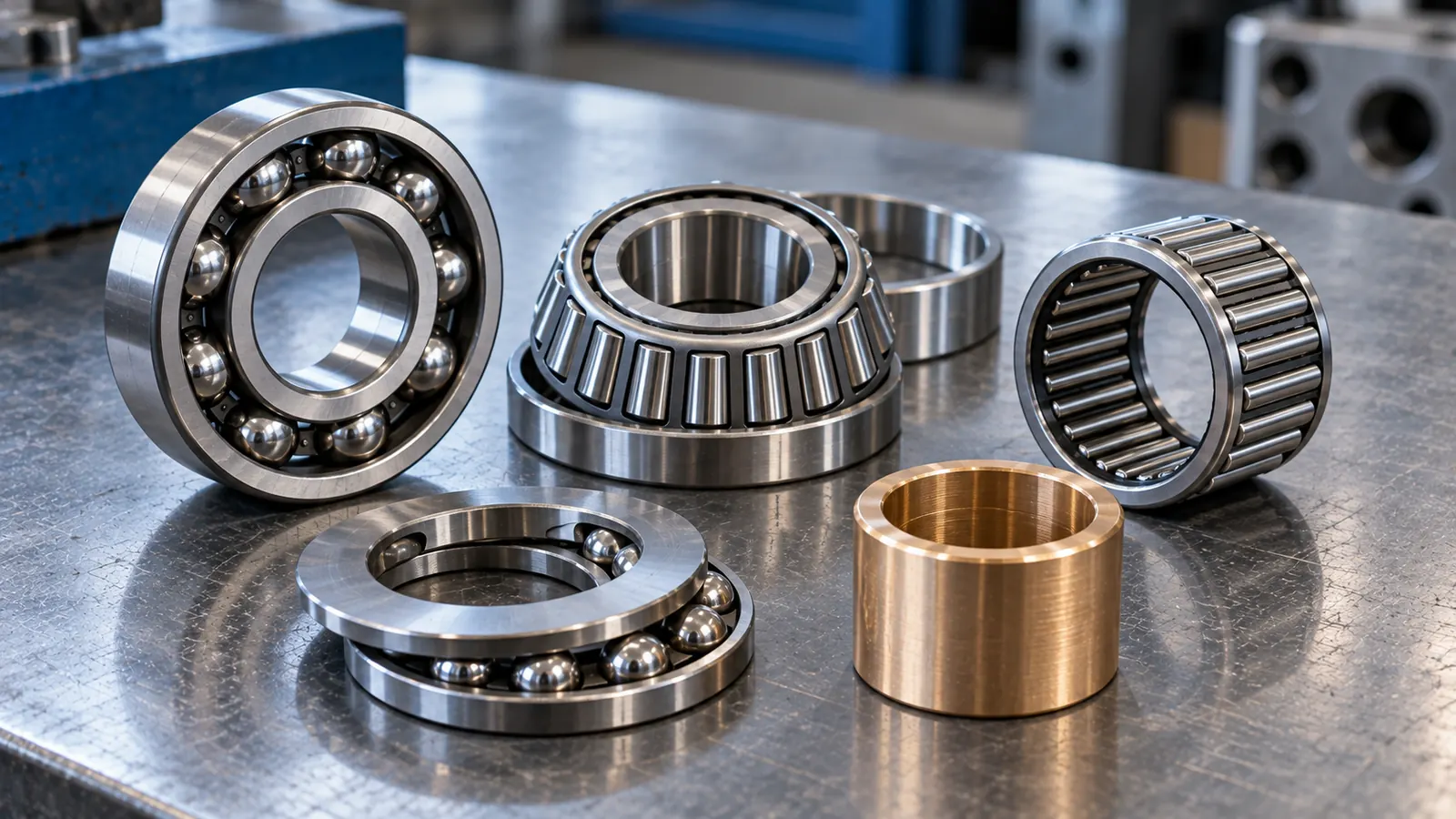
The main types of bearings are ball bearings (deep groove, angular contact, self-aligning, thrust), roller bearings (cylindrical, tapered, spherical, needle), plain bearings or bushings, and linear bearings. Ball bearings suit high speed and light to moderate loads. Roller bearings carry heavier loads because rollers make line contact. Plain bearings slide instead of roll and handle shock at low speed.
Key takeaways
- Radial load acts across the shaft; axial (thrust) load acts along it. Every bearing type is rated for one, the other, or both.
- A deep groove ball bearing such as the 6205 takes radial load plus moderate axial load in both directions.
- Tapered roller and angular contact bearings take combined loads in one axial direction and are usually mounted in pairs.
- Roller bearings carry more load than ball bearings of the same size; ball bearings run faster with less friction.
- Plain bearings (bushings) slide rather than roll and suit low speed, shock loads and oscillating motion.
What are the types of bearings?
Bearings fall into two big families: rolling-element bearings, where balls or rollers run between two rings, and plain bearings, where a shaft slides on a bearing surface. Linear bearings are a third group that guides straight-line motion instead of rotation.
Within rolling bearings the different types of bearings are named by the rolling element (ball, cylindrical roller, tapered roller, spherical roller, needle roller) and by the load direction they are built for (radial or thrust). Each type has a standard designation system, explained in how to read bearing numbers.
- Ball bearings: deep groove, angular contact, self-aligning, thrust ball.
- Roller bearings: cylindrical roller, tapered roller, spherical roller, needle roller, and their thrust versions.
- Plain bearings: bushings and sleeves in bronze, polymer, PTFE-lined steel, or babbitt.
- Linear bearings: ball bushings on round shafts, profile rail guides, and linear plain bushings.
Radial load vs axial load
Radial load acts at right angles to the shaft, like the belt pull on a pulley. Axial load, also called thrust load, acts along the shaft axis, like the push on a drill spindle. A combined load has both components. Choosing a bearing type starts with knowing which of these you have and how big each one is. The formulas that turn a combined load into one equivalent load are in bearing load ratings and life.
Bearing types chart: loads, speed and misalignment
This bearing types chart compares the common types qualitatively. Exact load ratings and speed limits depend on size and maker, so take them from the manufacturer's catalog.
| Bearing type | Radial load | Axial load | Speed | Misalignment | Typical uses |
|---|---|---|---|---|---|
| Deep groove ball | Moderate | Moderate, both directions | High | Very little | Electric motors, pumps, fans, gearboxes, appliances |
| Angular contact ball | Moderate | High, one direction per bearing | High | Very little | Machine tool spindles, pumps, worm gear shafts |
| Self-aligning ball | Light to moderate | Light | Moderate to high | Good | Long line shafts, agricultural and textile machinery |
| Thrust ball | None | Moderate, one or both directions | Low to moderate | None | Turntables, vertical shafts with light radial load |
| Cylindrical roller | High | None to light (depends on flange design) | High | Very little | Gearboxes, motors with belt drives, rolling mills |
| Tapered roller | High | High, one direction per bearing | Moderate | Very little | Wheel hubs, gear reducers, differentials, axles |
| Spherical roller | Very high | Moderate, both directions | Moderate | Good | Vibrating screens, conveyors, paper machines, crushers |
| Needle roller | High for its size | None | Moderate to high | Very little | Gear pumps, universal joints, rocker arms, transmissions |
| Plain bearing (bushing) | High, tolerates shock | Low unless flanged | Low to moderate | Some, depending on material | Pivots, linkages, hinges, slow heavy shafts |
| Linear bearing | Load across the rail or shaft | Not applicable (motion is along the axis) | Linear travel | Little | CNC axes, 3D printers, slides, automation |
Ball bearing types
Ball bearings use balls that touch the raceways at a small point, which keeps friction low and speed high. The four ball bearing types below cover almost all general machinery.
Deep groove ball bearing
The deep groove ball bearing is the most common bearing made. Its raceways are deep grooves with a radius slightly larger than the ball, so it takes radial load plus moderate axial load in both directions. The 60, 62, 63, 68 and 69 series on the bearing size chart are all deep groove ball bearings. A 6205 is 25 × 52 × 15 mm and a 608 is 8 × 22 × 7 mm. Most are available open, shielded (ZZ) or sealed (2RS); see 2RS vs ZZ bearings.
Angular contact ball bearing
An angular contact ball bearing has raceways offset so the load passes through the balls at an angle to the radial plane, called the contact angle. Common contact angles are 15°, 25°, 30° and 40°. A larger angle carries more axial load; a smaller angle suits higher speed. A single angular contact bearing takes axial load in one direction only, so they are mounted in pairs (back-to-back, face-to-face or tandem). A double row angular contact ball bearing combines two rows in one unit and takes axial load both ways. The single row 72 and 73 series share bore and outside diameter with the 62 and 63 deep groove series.
Self-aligning ball bearing
A self-aligning ball bearing has two rows of balls and a spherical outer raceway. The inner ring, balls and cage can tilt inside the outer ring, so the bearing tolerates shaft deflection and housing misalignment of a few degrees. Its load capacity is lower than a deep groove bearing of the same size because the balls contact a less conforming spherical surface.
Thrust ball bearing
A thrust ball bearing has two flat washers with grooves and a ring of balls between them. It takes axial load only and cannot carry radial load. Single direction types (51 series) take thrust one way; double direction types (52 series) take thrust both ways. They are not suited to high speeds because centrifugal force pushes the balls out of the grooves.
Roller bearing types
A roller bearing uses cylinders, tapered rollers, barrel-shaped rollers or needles instead of balls. Rollers make line contact with the raceways, which spreads load over a longer area, so a roller bearing carries more load than a ball bearing of the same envelope.
Cylindrical roller bearing
Cylindrical roller bearings carry high radial load and run at high speed. The flange arrangement sets the axial behavior: NU and N designs have flanges on one ring only, so the shaft can float axially and they take no thrust; NJ and NUP designs have extra flanges and take light axial load. They are often used as the floating bearing at one end of a shaft, with a locating bearing at the other end.
Tapered roller bearing
A tapered roller bearing has conical rollers running between a cone (inner ring) and cup (outer ring) whose raceways meet at a common point on the shaft axis. It carries heavy combined radial and axial load in one direction. Like angular contact bearings, they are mounted in opposed pairs and their axial clearance or preload is set at assembly. Metric single row tapered roller bearings use five-digit numbers such as 30205, which shares the 25 mm bore and 52 mm outside diameter of a 6205 but is wider. Inch tapered roller bearings use separate cone and cup part numbers, so a tapered roller bearing size chart must list both.
Spherical roller bearing
A spherical roller bearing has two rows of barrel-shaped rollers and a spherical outer raceway. It is self-aligning like a self-aligning ball bearing, but carries very high radial load and moderate axial load in both directions. It is the default heavy-duty roller bearing for shafts that deflect, such as conveyor pulleys and vibrating screens.
Needle roller bearings
A needle bearing is a cylindrical roller bearing with long, thin rollers. A common rule is that a roller counts as a needle when its length is several times its diameter. The low cross-section lets a needle bearing fit where a ball bearing would not, and it often runs directly on a hardened and ground shaft with no inner ring. Common needle roller bearings are:
- Drawn cup needle roller bearings: a thin pressed-steel outer cup, press-fitted into the housing. Open-ended (HK) and closed-end (BK) types are common.
- Machined-ring needle bearings: solid outer ring, with or without an inner ring (NA and RNA types), for higher loads.
- Needle roller and cage assemblies: rollers in a cage only, running on a hardened shaft and bore, as used in gear and connecting rod applications.
- Track rollers: heavy-walled outer rings that roll directly on a track or cam, either yoke type or stud type.
Needle thrust bearing and other roller thrust bearings
A needle thrust bearing (needle roller thrust bearing) is a flat cage of radially arranged needles running between two thin washers or between hardened faces of the parts. It takes high axial load in a very small axial space. Cylindrical roller thrust bearings and tapered roller thrust bearings carry heavier thrust, and spherical roller thrust bearings take heavy thrust plus some radial load and misalignment.
Roller bearing vs ball bearing
Choose a ball bearing for speed and low friction; choose a roller bearing for load and stiffness. The difference comes from contact shape: a ball touches the raceway at a point, a roller along a line.
| Factor | Ball bearing | Roller bearing |
|---|---|---|
| Contact with raceway | Point contact | Line contact |
| Load capacity for same size | Lower | Higher |
| Speed capability | Higher | Lower in most designs |
| Friction and heat | Lower | Higher |
| Stiffness | Lower | Higher |
| Shock load tolerance | Lower | Higher |
| Life equation exponent (ISO 281) | 3 | 10/3 |
| Typical price for same bore | Lower | Higher |
The life exponent matters in practice. For a ball bearing, halving the load multiplies the rated life by 2³ = 8; for a roller bearing it multiplies it by about 10.
Plain bearings and bushings
A plain bearing, also called a bushing or sleeve bearing, has no rolling elements: the shaft slides on a bearing surface separated by a lubricant film or a self-lubricating material. Plain bearings are simple, compact, quiet and tolerant of shock and contamination, but have higher starting friction than rolling bearings.
- Sintered bronze: porous bronze impregnated with oil, for light-duty motors and fans.
- Cast or wrapped bronze: grease-lubricated pivots and slow, heavily loaded shafts.
- PTFE-lined steel-backed bushings: dry running, low friction, thin wall.
- Engineering polymers (acetal, nylon, filled PTFE): light loads, corrosion resistance, no lubrication.
- Hydrodynamic journal bearings: babbitt or tri-metal shells running on an oil film, as in engines and turbines.
Use a plain bearing for oscillating motion such as linkage pivots, for very slow heavy shafts, and where a rolling bearing would fret or brinell under vibration without rotation.
Linear bearings and rails
A linear bearing guides motion along an axis instead of around it. The three common forms are linear ball bushings, profile rail guides and linear plain bearings.
- Ball linear bearing (ball bushing): recirculating balls in a sleeve that runs on a hardened, ground round shaft. Cheap and tolerant of slight misalignment, but the shaft must be supported to avoid sag.
- Linear bearings and rails (profile rail guides): a carriage with recirculating balls or rollers on a precision rail bolted to the machine. A linear bearing rail system is stiffer and more accurate than round-shaft bushings and is standard on CNC axes. A linear roller bearing carriage gives higher stiffness than a ball carriage of the same size.
- Linear plain bearings: polymer or bronze sleeves sliding on a shaft or rail. They tolerate dirt and wash-down better than recirculating ball types but have more friction.
Mounted linear bearings come in pillow blocks and flanged housings that bolt directly to a carriage plate.
How to choose a bearing type
Pick the bearing type from load direction first, then speed, misalignment and space. Work through these questions in order.
- Load direction: pure radial, use deep groove ball, cylindrical roller or needle; pure axial, use a thrust bearing; combined, use deep groove ball for moderate thrust, or angular contact or tapered roller pairs for heavy thrust.
- Load size: if a ball bearing that fits the space does not give enough life, move to a roller bearing.
- Speed: high speed favors deep groove and angular contact ball bearings and cylindrical roller bearings.
- Misalignment: if the shaft deflects or the housings cannot be aligned, use self-aligning ball or spherical roller bearings.
- Space: limited radial space points to thin-section 68 and 69 series ball bearings or needle bearings.
- Motion: oscillating or very slow motion often suits a plain bearing better than any rolling bearing.
- Environment: dirt and water call for sealed bearings; corrosion calls for stainless or ceramic, as covered in ball bearing materials.
Mounted and flange bearing types
Mounted bearing units put an insert bearing (a deep groove ball bearing with an extended inner ring and a set-screw or eccentric locking collar) in a cast-iron, steel or polymer housing. Common forms are pillow blocks, four-bolt square flanges, two-bolt oval flanges, three-bolt flanges and take-up units. They are used on conveyors and agricultural machinery where the shaft is not ground for a press fit. For bearings pressed into a bore, the shaft and housing fits in bearing fits and clearance apply.
Sources and standards
- ISO 15, Rolling bearings, radial bearings, boundary dimensions, general plan
- ISO 281
- ISO 5593
- ISO 355
General reference information. When a manufacturer, drawing or governing standard gives a value, that value takes precedence.
Related charts and guides
Common questions
What are the 4 types of bearings?
There is no single official list. A common four-way split is ball bearings, roller bearings, plain bearings and linear bearings. Another split, by rolling element, is ball, cylindrical roller, tapered roller and needle roller bearings. Fluid film and magnetic bearings are further special types used in turbines and high-speed machines.
What is the most common type of bearing?
The single row deep groove ball bearing is the most common type. It carries radial load plus moderate axial load in both directions at high speed. Familiar examples are the 6205, a 25 × 52 × 15 mm bearing used in motors and pumps, and the 608, an 8 × 22 × 7 mm bearing.
What is the difference between a roller bearing and a ball bearing?
A ball bearing has point contact between ball and raceway, so it runs faster with lower friction. A roller bearing has line contact, so it carries more load and is stiffer for the same size. In the ISO 281 life equation the exponent is 3 for ball bearings and 10/3 for roller bearings.
What is a needle bearing used for?
A needle bearing is used where radial space is tight but radial load is high, such as gear pumps, universal joints, rocker arms, transmission gears and connecting rods. Its rollers are long and thin, and it often runs directly on a hardened, ground shaft without an inner ring, which saves further space.
Which bearing types take axial load?
Thrust ball and thrust roller bearings take axial load only. Angular contact ball bearings and tapered roller bearings take heavy combined loads but only one axial direction per bearing, so they are paired. Deep groove ball bearings and spherical roller bearings take moderate axial load in both directions. Most cylindrical roller and needle bearings take none.
What is a linear bearing?
A linear bearing supports and guides motion along a straight line. Ball bushings run on hardened round shafts, profile rail guides use a carriage with recirculating balls or rollers on a precision rail, and linear plain bearings slide on a polymer or bronze liner. Profile rails are the stiffest and most accurate type.
When should I use a plain bearing instead of a rolling bearing?
Use a plain bearing or bushing for oscillating motion, very slow heavily loaded shafts, shock loads, dirty conditions and tight spaces. Rolling bearings are better for continuous rotation at moderate to high speed where low starting friction and accurate shaft location matter.